Glagov revisited: coronary artery disease phenotype on non-invasive imaging provides rationale for implementing preventive pharmacotherapy—a case report
European Heart Journal - Case Reports


Abstract
Glagov
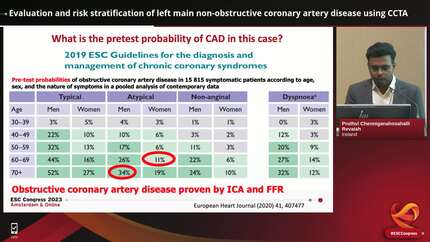
A 69-year-old non-smoking female with hypertension, dyslipidaemia, and hypothyroidism presented with atypical chest pain. Electrocardiogram and left ventricular ejection fraction were normal. Her lipidic profile was normal. CCTA showed a lipid-rich plaque with very low attenuation (<30 HU) in the left main stem (LMS) extending into the proximal left anterior descending (LAD) and in the mid LAD artery. The maximum plaque burden in the LMS was 67% with a remodelling index of 1.375, and an area stenosis of 22%. Tissue characterization showed a lipid-rich plaque with a thin fibrous cap. The perivascular fat attenuation index (FAI) in the proximal LAD was suggestive of (−69 HU) inflamed perivascular fat. Shear stress analysis of the LMS plaque showed normal wall shear stress (WSS); however, the axial plaque stress was high. Her medications were intensified to rosuvastatin 20 mg once daily (OD) and ezetimibe 10 mg OD. The patient remained asymptomatic at 6 months follow-up.
Our case exemplifies the value of CCTA as a diagnostic ‘one-stop shop’ (CCTA, finite element analysis, computed tomographic density [CTD], tissue characterization analysis, FAI analysis, WSS and wall strain, and etc.) when stratifying a patient with non-obstructive CAD. With further development of novel potent anti-lipidaemic and anti-inflammatory drugs, non-obstructive lesions with adverse plaque and haemodynamic parameters will have the opportunity to be treated with additional preventive pharmacological therapy.
Contributors

Pruthvi C Revaiah
Author

Denise P Yates
Author
Yoshinobu Onuma
Author
Jose Luis Zamorano
Author
Tina Khan
Author
Raheel Ahmed
Author
Lavanya Athithan
Author
You may be interested in