In vivo predictors of plaque erosion in patients with ST-segment elevation myocardial infarction: a clinical, angiographical, and intravascular optical coherence tomography study

European Heart Journal

13 March 2018
Organised by: Logo
ESC Journals CORONARY ARTERY DISEASE, ACUTE CORONARY SYNDROMES, ACUTE CARDIAC CARE Acute Coronary Syndromes

Abstract

AbstractAims

Plaque erosion is a significant substrate of acute coronary thrombosis. This study sought to determine in vivo predictors of plaque erosion in patients with ST-segment elevation myocardial infarction (STEMI).

Methods and results

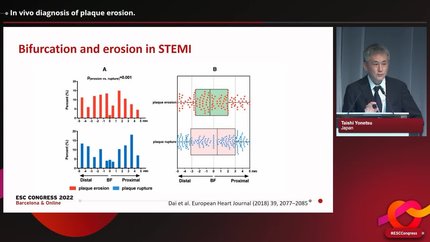
A prospective series of 822 STEMI patients underwent pre-intervention optical coherence tomography. Using established diagnostic criteria, 209 had plaque erosion (25.4%) and 564 had plaque rupture (68.6%). Plaque erosion was more frequent in women <50 years when compared with those ≥50 years of age (P = 0.009). There was a similar, but less striking, trend in men (P = 0.011). Patients with plaque erosion were more frequently current smokers but had fewer other coronary risk factors (dyslipidaemia, hypertension, chronic kidney disease, and diabetes mellitus) than those with plaque rupture. There was a preponderance of plaque erosion in the left anterior descending artery (LAD; 61.2%), whereas plaque rupture was more equally distributed in both the LAD (47.0%) and right coronary artery (43.3%). Despite the similar spatial distribution of erosions and ruptures over the lengths of the coronary arteries, plaque erosion occurred more frequently near a bifurcation (P < 0.001). In the multivariable analysis, age <50 years, current smoking, absence of other coronary risk factors, lack of multi-vessel disease, reduced lesion severity, larger vessel size, and nearby bifurcation were significantly associated with plaque erosion. Nearby bifurcation and current smoking were especially notable in men, while age <50 years was most predictive in women.

Conclusions

Plaque erosion was a predictable clinical entity distinct from plaque rupture in STEMI patients, and gender-specific role of risk factors in plaque erosion should be considered.

Contributors

Lei Xing
Lei Xing

Author

Lin Lin
Lin Lin

Author

Lijia Ma
Lijia Ma

Author

Maoen Xu
Maoen Xu

Author

Huai Yu
Huai Yu

Author

Lulu Li
Lulu Li

Author

Bo Yu
Bo Yu

Author

Harbin Medical University Harbin , China

ESC 365 is supported by