Optimizing electrophysiology studies to prevent sudden cardiac death after myocardial infarction
EP Europace Journal


Abstract
This study assessed associations of minimum final extrastimulus coupling interval utilized within electrophysiology study (EPS) after myocardial infarction (MI) and possible site of origin of induced ventricular tachycardia (VT) with long-term occurrence of spontaneous ventricular tachyarrhythmia and long-term survival.
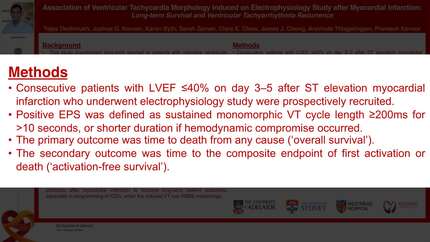
This prospective study recruited consecutive patients with left ventricular ejection fraction (LVEF) ≤ 40% who underwent EPS days 3–5 after MI between 2004 and 2017. Positive EPS was defined as sustained monomorphic VT cycle length ≥200 ms for ≥10 s or shorter duration if haemodynamic compromise occurred. Each of the four extrastimuli was shortened by 10 ms at a time, until it failed to capture the ventricle (ventricular refractoriness) or induced ventricular tachyarrhythmia. Outcomes included spontaneous ventricular tachyarrhythmia occurrence and all-cause mortality. Shorter coupling interval length of final extrastimulus that induced VT was associated with higher risk of spontaneous ventricular tachyarrhythmia (
Ventricular tachycardia induced with shorter coupling intervals was associated with higher risk of spontaneous ventricular tachyarrhythymia on follow-up, indicating that the final extrastimulus coupling interval at EPS early after MI should be determined by ventricular refractoriness. Induced VT with possible origin from left ventricle was associated with increased risk of spontaneous ventricular tachyarrhythmia recurrence or death.
Contributors

Joshua G Kovoor
Author

Amy von Huben
Author
Simone L Marschner
Author
Karen Byth
Author
Clara K Chow
Author
Sarah Zaman
Author
James J H Chong
Author
Aravinda Thiagalingam
Author
You may be interested in