Machine-learning versus traditional approaches for atherosclerotic cardiovascular risk prognostication in primary prevention cohorts: a systematic review and meta-analysis
European Heart Journal - Quality of Care and Clinical Outcomes


Abstract
Cardiovascular disease (CVD) risk prediction is important for guiding the intensity of therapy in CVD prevention. Whilst current risk prediction algorithms use traditional statistical approaches, machine learning (ML) presents an alternative method that may improve risk prediction accuracy. This systematic review and meta-analysis aimed to investigate whether ML algorithms demonstrate greater performance compared with traditional risk scores in CVD risk prognostication.
MEDLINE, EMBASE, CENTRAL, and SCOPUS Web of Science Core collections were searched for studies comparing ML models to traditional risk scores for CVD risk prediction between the years 2000 and 2021. We included studies that assessed both ML and traditional risk scores in adult (≥18 year old) primary prevention populations. We assessed the risk of bias using the Prediction Model Risk of Bias Assessment Tool (PROBAST) tool. Only studies that provided a measure of discrimination [i.e.
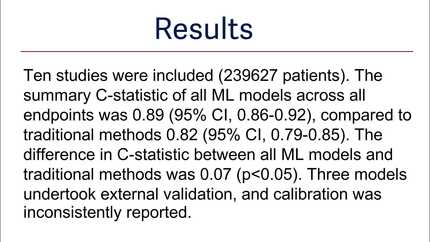
ML models outperformed traditional risk scores in the discrimination of CVD risk prognostication. Integration of ML algorithms into electronic healthcare systems in primary care could improve identification of patients at high risk of subsequent CVD events and hence increase opportunities for CVD prevention. It is uncertain whether they can be implemented in clinical settings. Future implementation research is needed to examine how ML models may be utilized for primary prevention.
This review was registered with PROSPERO (CRD42020220811).
Contributors

Weber Liu
Author


Jason Chiang
Author
Jason Yue
Author
Simone Marschner
Author
Juan C Quiroz
Author
Louisa Jorm
Author

You may be interested in