Atrial Fibrillation can adversely impact Heart Failure with Preserved Ejection Fraction by its association with Heart Failure Progression and Mortality: A Post-Hoc Propensity Score–Matched Analysis of the TOPCAT Americas Trial
EP Europace Journal


Abstract
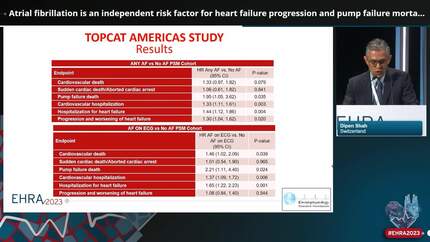
Prevalent atrial fibrillation (AF) is associated with excess cardiovascular (CV) death (D) and hospitalizations (H) in heart failure (HF) with preserved ejection fraction (pEF). We evaluated if it had an independent role in excess CVD in HFpEF and studied its impact on cause-specific mortality and HF morbidity.
We used propensity score–matched (PSM) cohorts from the TOPCAT Americas trial to account for confounding by other co-morbidities. Two prevalent AF presentations at study entry were compared: (i) subjects with Any AF event by history or on electrocardiogram (ECG) with PSM subjects without an AF event and (ii) subjects in AF on ECG with PSM subjects in sinus rhythm. We analyzed cause-specific modes of death and HF morbidity during a mean follow-up period of 2.9 years. A total of 584 subjects with Any AF event and 418 subjects in AF on ECG were matched. Any AF was associated with increased CVH [hazard ratio (HR) 1.33, 95% confidence interval (CI) 1.11–1.61,
Prevalent AF can be an independent risk factor for adverse CV outcomes by its selective association with worsening HF, HFH, and PFD in HFpEF. Prevalent AF was not associated with excess sudden death risk in HFpEF. Atrial fibrillation was also associated with HF progression in early symptomatic HFpEF and PFD in advanced HFpEF.
TOPCAT trial is registered at
Contributors


April Slee
Author
Andrea Natale
Author
Dhanunjaya R Lakkireddy
Author
Dipen Shah
Author
Luigi Di Biase
Author
Thorsten Lewalter
Author
Pasquale Santangeli
Author
You may be interested in