Development and validation of explainable machine learning models for risk of mortality in transcatheter aortic valve implantation: TAVI risk machine scores
European Heart Journal - Digital Health


Abstract
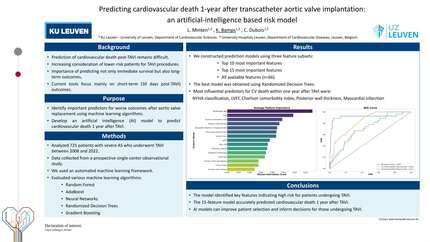
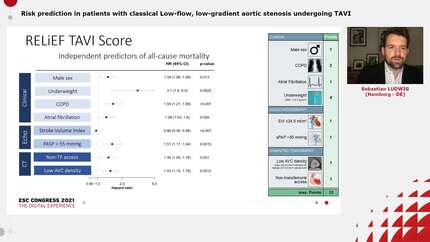
Identification of high-risk patients and individualized decision support based on objective criteria for rapid discharge after transcatheter aortic valve implantation (TAVI) are key requirements in the context of contemporary TAVI treatment. This study aimed to predict 30-day mortality following TAVI based on machine learning (ML) using data from the German Aortic Valve Registry.
Mortality risk was determined using a random forest ML model that was condensed in the newly developed TAVI Risk Machine (TRIM) scores, designed to represent clinically meaningful risk modelling before (TRIMpre) and in particular after (TRIMpost) TAVI. Algorithm was trained and cross-validated on data of 22 283 patients (729 died within 30 days post-TAVI) and generalisation was examined on data of 5864 patients (146 died). TRIMpost demonstrated significantly better performance than traditional scores [
TRIM scores demonstrate good performance for risk estimation before and after TAVI. Together with clinical judgement, they may support standardised and objective decision-making before and after TAVI.
Contributors

Andreas Leha
Author
Cynthia Huber
Author

Timm Bauer
Author
Andreas Beckmann
Author
Raffi Bekeredjian
Author
Sabine Bleiziffer
Author
Eva Herrmann
Author
Helge Möllmann
Author
Thomas Walther
Author

Christian Hamm
Author
Arnaud Künzi
Author
Stefan Stortecky
Author
Ingo Kutschka
Author

Stephan Ensminger
Author
Christian Frerker
Author
Tim Seidler
Author
You may be interested in