Very-early detection of atrial fibrillation in patients after ablation evaluated by a home-based wearable ECG-patch
EP Europace Journal


Abstract
Type of funding sources: None.
Evaluation of atrial fibrillation (AF) recurrence after AF ablation has been validated by routine ECG and ambulatory 24-h Holter monitoring after a 3-month blanking period. However, assessment of heart rhythm after AF ablation, conducted with the use of intermittent or continuous recording systems, has shown that early recurrences are common, often asymptomatic, and may predict late AF recurrences. The E-Patch (Bio Tel Heart) is an innovative thin, single-use adhesive electrode with extended continuous ECG monitoring for up to 120 hours.
To describe and characterize predictors of early AF recurrence based on the very- early blanking period after AF ablation.
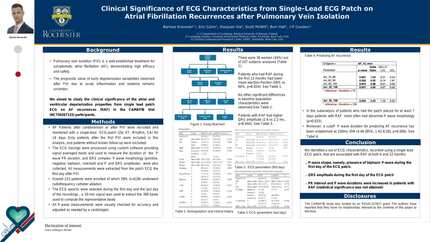
Single-centre, prospective, longitudinal study, including consecutive patients (P), 24 hours after AF ablation, monitored with the E- patch. Baseline characteristics at the time of AF ablation as well as the effectiveness of the device in continuously recording within 5 days after ablation were analyzed. A logistic regression model was used to derive predictors of very-early AF recurrence.
A total of 40P were included (60% male, 62±9 years). AF ablation was performed with radiofrequency energy in 23P and with cryoballoon in 17P. All P were in sinus rhythm at the beginning of the E- patch recording. The mean number of hours of recording was 113±18. During E-patch recording
11P (27.5%) presented AF (AF burden 27.4% of the recording, IQR 5.5-32.3%) and 7P (18%) had sinus pauses. In a multivariate logistic regression model, a higher CHADS2VAS2C index and a higher average heart were associated with an OR 3.0 (95% CI 1.13-8.1, p = 0.027) and OR 1.23 (95% CI 1.02-1.48, p = 0.025) for AF recurrence, respectively. No significant differences were found between ablation modalities. There were no complaints about discomfort in the use of the device, and there were no artefacts compromising the quality or the interpretation.
The use of the E-patch recording very-early after AF ablation is effective for AF detection. A higher CHADS2VAS2C index and average heart appear to be significantly predictive of very-early AF recurrence post-ablation.
Contributors

M Marques Antunes
Author
P Silva Cunha
Author
B Lacerda Teixeira
Author
S Alves
Author
G Portugal
Author
B Valente
Author
A S Delgado
Author
M Bras
Author
M Coutinho Cruz
Author
M Paulo
Author
A Lousinha
Author
C Guerra
Author
R Cruz Ferreira
Author
M Martins Oliveira
Author
You may be interested in