Incremental value of low-voltage area ablation in persistent atrial fibrillation: a systematic review and meta-analysis
EP Europace Journal


Abstract
Type of funding sources: None.
The optimal ablation approach for patients with persistent atrial fibrillation (AF) is a topic of high controversy. The efficacy of adjunctive ablation strategy beyond conventional pulmonary vein isolation remains uncertain.
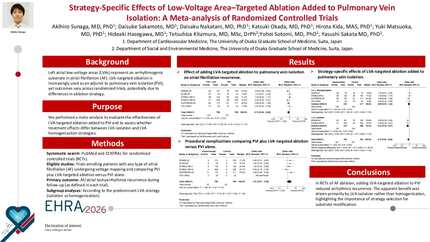
We sought to investigate the effectiveness of individualized low-voltage area (LVA) substrate modification in patients with persistent AF receiving conventional catheter ablation.
We systematically searched PubMed, Cochrane Library, and grey literature sources including clinicaltrials.gov, from inception to 1st November 2022, to identify relevant randomized controlled trials (RCTs). Patients with persistent AF undergoing conventional catheter ablation vs. ablation with additional LVA substrate modification were compared. Freedom from arrhythmia was set as the primary efficacy outcome and total procedure time as the secondary efficacy outcome. A prespecified subgroup analysis was performed for patients with presence of LVAs. We did not impose any filter regarding the study setting, sample size, study duration, or publication language. All analyses were performed using R version 4.1.0 and a two-sided p-value<0.05 was considered statistically significant.
We pooled data from 5 RCTs with a total of 989 participants (31% female) with persistent AF. Ablation with additional LVA substrate modification resulted in a significantly increased likelihood for freedom from arrhythmia by 60%, compared to conventional AF ablation (odds ratio 1.60; 95% confidence interval 1.13-2.28; I2=39%; p=0.009). No difference in the total procedure time was identified between the two approaches (mean difference -28.94 min; 95% confidence interval -69.39 to 11.51 min; I2 = 98%, p=0.16). In patients with LVAs (n=240), additional LVA substrate modification yielded a higher probability for freedom from arrhythmia than conventional AF ablation (odds ratio 1.73; 95% confidence interval 1.03-2.90; I2=0%; p=0.04).
This meta-analysis demonstrates that an individualized ablation approach with low-voltage area substrate modification is associated with improved outcomes in patients with persistent AF.
Forest plot for freedom from arrhythmia
Forest plot for total procedure time
Contributors

M Toumpourleka
Author
D Patoulias
Author
A P Antoniadis
Author
K Triantafyllou
Author
G Giannopoulos
Author
M Meletidou
Author
M Karamanidou
Author
N Fragakis
Author
V Vassilikos
Author
You may be interested in