Extreme cardiac remodelling observed in elite endurance athletes: analysis of myocardial deformation and estimated hemodynamic forces
European Journal of Preventive Cardiology


Abstract
Type of funding sources: None.
Athletes of endurance disciplines present the highest level of cardiac remodelling often generating concerns for differential diagnosis with cardiomyopathies. In addition to standard morpho-functional evaluation, left ventricle (LV) myocardial deformation (MD) and estimated intra-ventricular hemodynamic forces (HDFs) are emerging diagnostic tools, particularly in heart failure patients. In the athletic population MD data are scarce while HDFs are lacking.
To describe MD and HDFs evaluated by CMR feature-tracking in a cohort of endurance Olympic athletes and to evaluate the possible relationship with LV geometry.
A group of endurance Olympic athletes evaluated prior the Olympic games and with unremarkable cardiac pre-participation screening tests was enrolled. All athletes underwent CMR without contrast administration. Cine images were post-processed to evaluate end-diastolic and end-systolic LV volumes, ejection fraction (LVEF), global longitudinal and circumferential strain (GLS and GCS) and estimated HDFs by a dedicated feature-tracking software. HDFs were measured in apex-base (AB) and latero-septal (LS) directions, over the entire cardiac cycle, in systole and diastole. LS/AB ratio was also derived to determine forces distribution. Athletes were divided in subgroups according to the 3D sphericity index (< 40% or 40%). A group of sedentary subjects was enrolled as a control group.
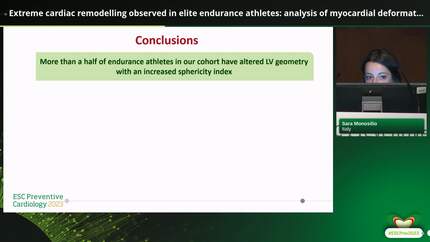
109 endurance Olympic athletes (62% male; mean age 26 ± 5 years) and 21 sedentary subjects were enrolled. Athletes with increased sphericity index (≥40%) were 61 (56%) and presented with greater EDV, ESV and lower LVEF compared to those without increased sphericity and controls (Table). No significant differences were found between athletes and controls regarding LV-GLS and GCS. HDFs distribution was not different between groups and even athletes with a more spherical LV shape showed an HDFs diastolic ratio comparable to those of athletes with lower sphericity index and control.
Although more than half of endurance athletes presented with altered geometry (increased sphericity index), strain parameters and hemodynamic forces were not different from sedentary controls and those athletes without increased sphericity. The use of advanced parameters to evaluate cardiac function could be used as a tool to confirm the benign nature of cardiac adaptation due to intense exercise training.
Table
Figure
Contributors

S Monosilio
Author
S Prosperi
Author
A Ciuffreda
Author
E Lemme
Author
G Di Gioia
Author
R Mango
Author
G Pedrizzetti
Author
G Tonti
Author
G Gualdi
Author
A Pelliccia
Author
M R Squeo
Author
V Maestrini
Author
You may be interested in