Cardiac hemodynamic responses to exercise training in patients with coronary heart disease
European Journal of Preventive Cardiology


Abstract
Type of funding sources: None.
In coronary heart disease (CHD) patients, tailored training programs are strongly recommended to decrease cardiovascular mortality but factors responsible for a positive response to training remain unclear.
The aim of this study was to compare cardiac hemodynamic parameters changes after a training program in CHD patients, according to the training responder’s status.
72 CHD patients (78% males, 63±9y) were recruited to perform a 12-week training consisting in a combination of endurance and endurance sessions.
Patients underwent 2 cardiopulmonary exercise testing (CPET) using a ramp protocol (10 to 15 W/min) on a cycle ergometer pre- and post-training. Hemodynamic parameters (e.g., cardiac output (CO), cardiac index (CI), stroke volume (SV), systemic vascular resistance (SVR)) were measured by bioimpedance, and CPET parameters (e.g., peak oxygen uptake (O2peak)) were also measured pre- and post-training.
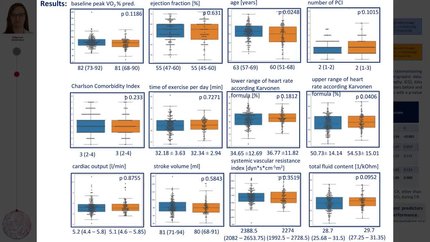
Patients were divided in 2 groups (responders-R and non-responders-NR) according to the median change in O2peak.
In the R group, O2peak (+16.8%, p < 0.001), CO, CI and SV increased by16.6%, 16.8% and 13.0%, respectively (p < 0.01) after the training program. In the NR group, O2peak, CO, CI and SV increased by 0.48%, 5.12%, 8.07% and 5.75%, respectively (p < 0.01). The SVR decreased in both groups (-19.0% in R and -11.4% in NR, p < 0.001).
The R group of CHD patients showed better improvement in cardiac hemodynamic and CPET parameters after a 12-week training program than NR. Further studies are needed to determine the best way to individualize training programs for the non-responders.
Contributors

M K Kirsch
Author
D V Vitiello
Author
L D T Trachsel
Author
M B Boidin
Author
J L Lalonge
Author
M J Juneau
Author
L B Bherer
Author
A N Nigam
Author
M G Gayda
Author
You may be interested in