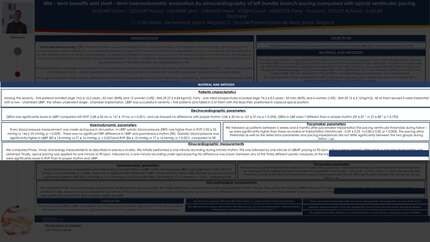
Comparison of methods for delivering cardiac resynchronization therapy: an acute electrical and haemodynamic within-patient comparison of left bundle branch area, His bundle, and biventricular pacing
EP Europace Journal


Abstract
Left bundle branch area pacing (LBBAP) is a promising method for delivering cardiac resynchronization therapy (CRT), but its relative physiological effectiveness compared with His bundle pacing (HBP) is unknown. We conducted a within-patient comparison of HBP, LBBAP, and biventricular pacing (BVP).
Patients referred for CRT were recruited. We assessed electrical response using non-invasive mapping, and acute haemodynamic response using a high-precision haemodynamic protocol. Nineteen patients were recruited: 14 male, mean LVEF of 30%. Twelve had time for BVP measurements. All three modalities reduced total ventricular activation time (TVAT), (ΔTVATHBP -43 ± 14 ms and ΔTVATLBBAP −35 ± 20 ms vs. ΔTVATBVP −19 ± 30 ms,
HBP delivered better ventricular resynchronization than LBBAP because right ventricular activation was slower during LBBAP. But LBBAP was not inferior to HBP with respect to LV electrical resynchronization and acute haemodynamic response.
Contributors

Nadine Ali
Author

Ahran D Arnold
Author
Imperial College London London , United Kingdom of Great Britain & Northern Ireland
Alejandra A Miyazawa
Author
Daniel Keene
Author
Ji-Jian Chow
Author
Ian Little
Author
Nicholas S Peters
Author
Prapa Kanagaratnam
Author
Norman Qureshi
Author

Fu Siong Ng
Author
Imperial College London London , United Kingdom of Great Britain & Northern Ireland
Nick W F Linton
Author
David C Lefroy
Author
Darrel P Francis
Author
Lim Phang Boon
Author

Mark A Tanner
Author
St Richard's Hospital Chichester , United Kingdom of Great Britain & Northern Ireland
Amal Muthumala
Author
Matthew J Shun-Shin
Author
Graham D Cole
Author
Zachary I Whinnett
Author
You may be interested in