Reverse longitudinal stent deformation during percutaneous intervention via the retrograde approach to a chronic total occlusion of the right coronary artery: a case report
European Heart Journal - Case Reports


Abstract
Longitudinal stent deformation (LSD) is an uncommon but recognized mechanical complication of coronary stent implantation, usually occurring at the proximal stent edge due to compression by guide catheter or catheter extensions. Retrograde techniques for chronic total occlusion (CTO) percutaneous coronary intervention expose the distal stent edge to potential interaction with retrograde equipment under a tensioned system.
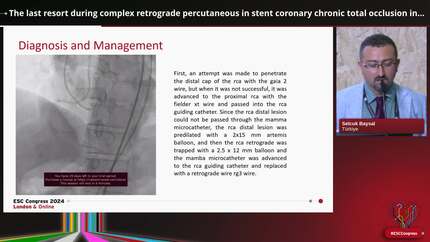
We describe a case of distal stent edge LSD, occurring during a retrograde approach to a right coronary artery CTO via septal collateral channels. While removing the externalized wire, interaction with the retrograde microcatheter caused compression of the distal end of the newly implanted stents.
This unusual complication highlights the reduced longitudinal strength of newer generation stent platforms and the risks of interaction between retrograde equipment and stents on an externalized wire.
Contributors


Marciej Marciniak
Author
James C Spratt
Author
St George's University Hospital NHS Foundation Trust London , United Kingdom of Great Britain & Northern Ireland
Dejan Milasinovic
Author
Pierre Deharo
Author
Piotr Nikodem Rudzínski
Author
Reshma Amin
Author
Deepti Ranganathan
Author
You may be interested in