Utility of coherent and ripple mapping for post-mitral valve plasty biatrial macro-re-entrant tachycardia: a case report
European Heart Journal - Case Reports


Abstract
Biatrial tachycardia (BiAT) is a rare form of atrial macro-re-entrant tachycardia. Precise identification of interatrial connections and circuits of the BiAT is difficult. And incomplete understanding of the re-entrant circuit may lead to unnecessary ablation, thus increasing the risk of complications.
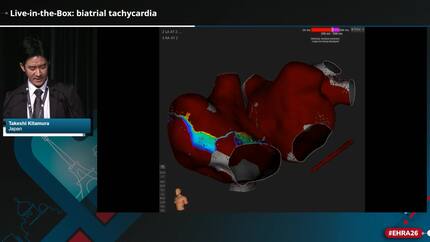
A 69-year-old man with a history of mitral valve plasty for mitral regurgitation due to mitral valve prolapse was admitted for persistent atrial tachycardia. Electrophysiological examination using the CARTO mapping system was performed. A coherent map revealed an atrial tachycardia with a cycle length of 304 ms and a re-entrant circuit involving the left atrial septum and right atrial septum, while a ripple map suggested an epicardial interatrial connection between the right atrium and left atrium. Radiofrequency ablation on the epicardial connection successfully terminated BiAT without complications.
In BiAT using both atrial septum as a re-entrant circuit, an interatrial connection or an atrial septum can be the target site for ablation. However, septal ablation can be challenging because of the risk of atrioventricular block or interatrial conduction delay, and minimal line or point ablation is needed. Coherent and ripple mapping can accurately determine the re-entrant circuit and interatrial connection of BiAT and reduce complication risks by terminating the atrial tachycardia with minimal ablation.
Contributors

Yasuteru Yamauchi
Author
Kaoru Okishige
Author
Tetsuo Sasano
Author
Philipp Sommer
Author
Richard Ang
Author
Konstantinos Iliodromitis
Author
Alex Tindale
Author
Ross Thomson
Author
You may be interested in