Pathological assessment of very late bare metal stent thrombosis in the left main coronary artery: a case report
European Heart Journal - Case Reports


Abstract
Late catch-up phenomenon following stent implantation is a well-known complication. However, no report has evaluated thrombosis after 9 years with multi-modality and pathological evaluation.
A 71-year-old man with stable angina underwent elective percutaneous intervention of the left main coronary artery with implantation of a bare metal stent (BMS) 9 years ago. At the 9-year follow-up, coronary computed tomography (CCT) and coronary angiography (CAG) findings revealed a thrombus-like structure in the BMS slightly protruding into the sinus of Valsalva. Therefore, the previously prescribed double-antiplatelet therapy was replaced with an anticoagulant and clopidogrel, and a potent statin treatment was initiated. After the changes in drug treatment, follow-up examinations with CCT at 1 and 3 months suggested a decrease in the size of the thrombus; however, it appeared to increase after 6 months. Subsequently, the patient underwent surgical intervention. Pathological assessment of the explanted stent showed a proteoglycan-dominated extracellular matrix with few smooth muscle cells suggesting an organized thrombus.
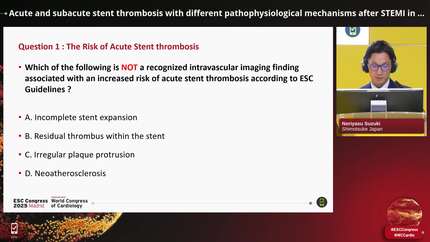
It should be emphasized that multiple factors might be responsible for very late stent thrombosis, such as peri-stent strut chronic inflammation involving proteoglycans, stent protrusion, and poorly controlled type 2 diabetes mellitus, possibly further inducing inflammatory cells.
Contributors

Haruhito Yuki
Author
Gaku Nakazawa
Author
Sunao Nakamura
Author
Aref Bin Abdulhak
Author
Mohamed Farag
Author
Arvind Singh
Author
Kyriakos Dimitriadis
Author
Carazo Minguito Carlos
Author
Ross Thomson
Author
You may be interested in