Continued vs. interrupted direct oral anticoagulants at the time of device surgery, in patients with moderate to high risk of arterial thrombo-embolic events (BRUISE CONTROL-2)
European Heart Journal


Abstract
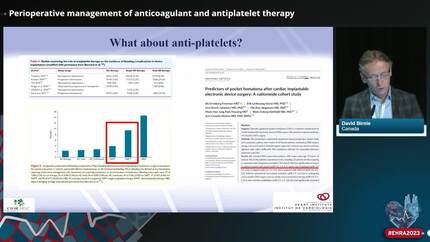
Guidelines recommend warfarin continuation rather than heparin bridging for pacemaker and defibrillator surgery, after the BRUISE CONTROL trial demonstrated an 80% reduction in device pocket haematoma with this approach. However, direct oral anticoagulants (DOACs) are now used to treat the majority of patients with atrial fibrillation. We sought to understand the best strategy to manage the DOACs at the time of device surgery and specifically hypothesized that performing device surgery without DOAC interruption would result in a reduced haematoma rate.
We randomly assigned patients with atrial fibrillation and CHA2DS2-VASc score ≥2, to continued vs. interrupted DOAC (dabigatran, rivaroxaban, or apixaban). The primary outcome was blindly evaluated, clinically significant device pocket haematoma: resulting in re-operation, interruption of anticoagulation, or prolonging hospital stay. In the continued arm, the median time between pre- and post-operative DOAC doses was 12 h; in the interrupted arm the median time was 72 h. Clinically significant haematoma occurred in of 7 of 328 (2.1%; 95% CI 0.9–4.3) patients in the continued DOAC arm and 7 of 334 (2.1%; 95% CI 0.9–4.3) patients in the interrupted DOAC arm (
These results suggest that, dependent on the clinical scenario, either management strategy (continued DOAC or interrupted DOAC) might be reasonable, at least for patients similar to those enrolled in our trial.
Contributors


Jeff S Healey
Author
George A Wells
Author
Felix Ayala-Paredes
Author
Benoit Coutu
Author
Glen L Sumner
Author
Giuliano Becker
Author
Atul Verma
Author
François Philippon
Author
Eli Kalfon
Author
John Eikelboom
Author
Roopinder K Sandhu
Author
Pablo B Nery
Author
Nicholas Lellouche
Author
Stuart J Connolly
Author
John Sapp
Author
Vidal Essebag
Author
You may be interested in