Multiple lipomata of the tricuspid valve and papillary muscle: case report
European Heart Journal - Case Reports


Abstract
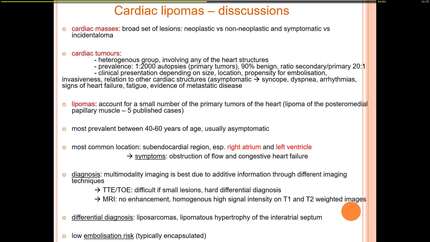
Cardiac lipomas are rare benign primary tumours of the heart. Due to the nature of these tumours, they are often asymptomatic and diagnosed incidentally. Whether asymptomatic patients with cardiac lipomas should perform surgery still remains controversial.
A 34-year-old Asian male who was incidentally found hyperechoic masses in the right ventricle (RV) on the transthoracic echocardiogram by annually routine physical examination was admitted to our cardiology department. His medical history was unremarkable. The repeated transthoracic and transoesophageal echocardiogram showed multiple solitary and well-demarcated masses in the RV. On the cardiac magnetic resonance imaging, four discrete masses (considering the possibility of it being a lipoma) partially occluding the right ventricular outflow tract (RVOT) were observed. During the open-heart resection surgery, it was found that the tricuspid valve and papillary muscle were covered by multiple adipose masses in the RV that arose from the interventricular septum and the free wall, resulting in partial RVOT obstruction. These excised masses were histopathologically confirmed as lipomata characterized by the mature adipocytes with entrapped myocardial cells. The patient had no cardiac abnormality in the 1-month follow-up after the surgery.
This rare clinical case of multiple lipomata of the tricuspid valve and papillary muscle acknowledges that multimodality imaging is the cornerstone for the assessment and diagnosis. Surgery should be performed in cases of symptomatic or large lipomas as well as when a lipoma is considered to be high risk because of RVOT obstruction.
Contributors

Yixin Zhao
Author
Guoliang Li
Author
Shun Wang
Author
Mark Abela
Author
Luca Arcari
Author
Stefano Albani
Author
Brett Sydney Bernstein
Author
Katharine Kott
Author
You may be interested in