Novel atrioventricular sequential pacing approach using a transvenous atrial pacemaker and a leadless pacemaker: a case report
European Heart Journal - Case Reports


Abstract
The use of transvenous pacing leads is associated with the risk of developing tricuspid valve (TV) dysfunction. This develops through several mechanisms including the failure of leaflet coaptation or direct damage to the TV or to its sub-valvular apparatus and can result in significant tricuspid regurgitation (TR). Multiple approaches to pacemaker implantation after transvenous lead extraction (TLE) or surgical TV repair have been described. Placement of pacing leads across the TV is generally avoided in such circumstances.
A 66-year-old woman presented with a year-long history of exertional dyspnoea, peripheral oedema, and postural neck pulsations. Her medical history included a dual-chamber pacemaker implantation for sinus node dysfunction 14 years ago. Echocardiography revealed severe lead-related TR. Her case was discussed in our multi-disciplinary team meeting. A decision was made to perform a TLE and implant a leadless pacemaker in an attempt to avoid open-heart surgery if possible. This was reserved as an option in the event of persistent severe TR. Transvenous extraction of the right ventricular lead was performed. The atrial lead was preserved and connected to and AAI device. A Micra AV was implanted allowing for atrioventricular (AV) synchronous pacing.
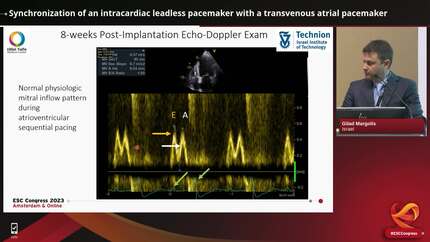
We present the first case of successful implementation of AV sequential pacing using a dual-pacemaker approach involving the use of an AAI pacemaker and a Micra AV device. This was performed after TLE for severe lead-related TR.
Contributors


Frances Devereux
Author
Fozia Zahir Ahmed
Author
Peter Scott
Author
Colin Cunnington
Author
Amir Zaidi
Author
David Duncker
Author
Christoph Sinning
Author
Jalaj Garg
Author
Markus Bettin
Author
Carlos Minguito Carazo
Author
Vishal Shahil Mehta
Author
You may be interested in