Eosinophilic perimyocarditis associated with eosinophilic granulomatosis with polyangiitis: a case report
European Heart Journal - Case Reports


Abstract
Eosinophilic myocarditis (EM) is a rare and potentially life-threatening form of myocarditis, frequently (but not always) associated with eosinophilia, and presents with acute chest pain, or signs and symptoms of acute or chronic heart failure. Eosinophilic myocarditis has various aetiologies, including eosinophilic granulomatosis with polyangiitis (EGPA).
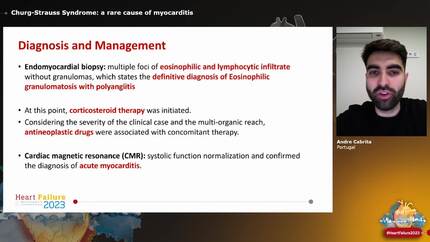
A 52-year-old female with a long-standing history of asthma, acral paraesthesia, subcutaneous nodules, and recurrent chest pain treated with anti-inflammatory drugs was admitted to our hospital with chest pain, repolarization disturbances, eosinophilia, and increased troponin levels. After an initial evaluation by coronary angiography, echocardiography and cardiac magnetic resonance, a definitive diagnosis of EM was made with the help of an endomyocardial biopsy. The aetiological diagnosis of EM as a manifestation of tissue involvement in EGPA was concluded after ruling out other possible causes of eosinophilia and with the help of other diagnostic criteria for EGPA (asthma, eosinophilia, and neuropathy). Therefore, we started with a high dosage of glucocorticoids, and attained relief of symptoms and normalization of eosinophilic count after a few days.
In cases of myocarditis (particularly if associated with eosinophilia), EM is a manifestation of EGPA and should be considered for a prompt differential diagnosis. Endomyocardial biopsy represents the gold standard for the diagnosis of EM. The mainstay of therapy for EM is immunosuppressive drugs to help prevent its evolution to a fulminant form and chronic progression towards restrictive cardiomyopathy.
Contributors

Maria Luisa De Perna
Author
Michael Reinehr
Author
Giovanni Pedrazzini
Author
Alberto Bouzas-Mosquera
Author
Enrique Garcia-Sayan
Author
Max Sayers
Author
Mariame Chakir
Author
You may be interested in