Concrete proof of Murphy’s law: a case report of intracardiac cement embolization
European Heart Journal - Case Reports


Abstract
The literature describing the complications following kyphoplasty is limited. This case report is a reminder that novel therapeutic strategies can be associated with unexpected complications.
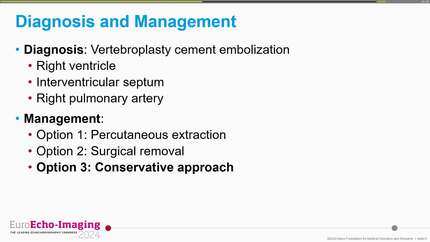
A 61-year-old woman with rheumatoid arthritis and degenerative lumbar disc disease underwent open posterior instrumented fusion with bilateral open L2 vertebroplasty elsewhere. A month after discharge, she presented to our institution with acute chest pain and dyspnoea. A subsequent gated cardiac computed tomography (CT) angiogram showed three distinct cardiopulmonary emboli. One of the cement fragments had perforated the inferior wall of the right ventricle close to the base of the posterior tricuspid valve leaflet with a moderate circumferential pericardial effusion. Operative extraction of multiple cement emboli as well as repair of the tricuspid valve was pursued. Postoperative echocardiogram showed trivial tricuspid regurgitation after repair. The patient had an uneventful postoperative course and was discharged from the hospital on postoperative Day 5.
Cement embolization following kyphoplasty can be associated with serious complications such as vascular injury, hypoxaemia, pulmonary artery obstruction, and cardiac perforation. Clinicians must maintain a high index of suspicion as cement embolism may not always present acutely.
Contributors

Ramaprabhu Krithika
Author
Jeffrey B Geske
Author
Hector R Villarraga
Author
Michel Pompeu Sá
Author
Jan Henzel
Author
Debbie Falconer
Author
Deepti Ranganathan
Author
Katharine Kott
Author
You may be interested in