Combining European and U.S. risk prediction models with polygenic risk scores to refine cardiovascular prevention: the CoLaus|PsyCoLaus Study
European Journal of Preventive Cardiology


Abstract
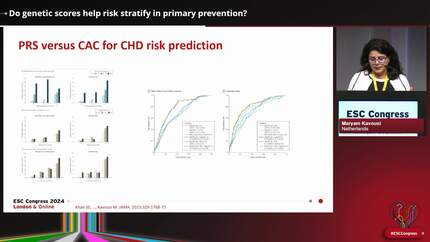
A polygenic risk score (PRS) has the potential to improve individual atherosclerotic cardiovascular disease (ASCVD) risk assessment. To determine whether a PRS combined with two clinical risk scores, the Systematic COronary Risk Evaluation 2 (SCORE2) and the Pooled Cohort Equation (PCE) improves the prediction of ASCVD.
Using a population-based European prospective cohort, with 6733 participants at the baseline (2003–2006), the PRS presenting the best predictive accuracy was combined with SCORE2 and PCE to assess their joint performances for predicting ASCVD Discrimination, calibration, Cox proportional hazard regression, and net reclassification index were assessed. : 4218 subjects (53% women; median age, 53.4 years), with 363 prevalent and incident ASCVD, were used to compare four PRSs. The metaGRS_CAD PRS presented the best predictive capacity (AUROC = 0.77) and was used in the following analyses. 3383 subjects (median follow-up of 14.4 years), with 190 first-incident ASCVD, were employed to test ASCVD risk prediction. The changes in C statistic between SCORE2 and PCE models and those combining metaGRS_CAD with SCORE2 and PCE were 0.008 (95% CI, −0.00008–0.02,
Combining a PRS with clinical risk scores significantly improved the reclassification of risk for incident ASCVD for subjects in the clinically determined intermediate-risk category. Introducing PRSs in clinical practice may refine cardiovascular prevention for subgroups of patients in whom prevention strategies are uncertain.
Contributors

Christian W Thorball
Author
Claire Redin
Author
Stephane Fournier
Author
Olivier Müller
Author
Davide Strambo
Author
Patrik Michel
Author
Peter Vollenweider
Author
Pedro Marques-Vidal
Author
Jacques Fellay
Author
Julien Vaucher
Author
You may be interested in