Role of fibrinolysis after the generalization of the primary percutaneous coronary intervention in the setting of ST-Elevation Acute Myocardial Infarction
European Heart Journal - Acute CardioVascular Care


Abstract
Type of funding sources: None.
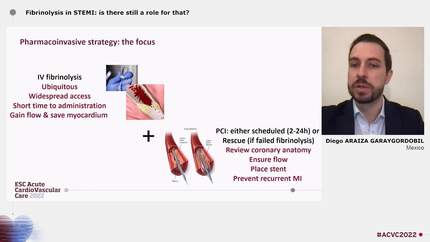
Primary percutaneous coronary intervention (PCI) is the treatment of choice in patients with ST-Elevation Acute Myocardial Infarction (STEMI). Fibrinolysis is relegated to situations in which the intervention cannot be performed in the appropriate time. The indications for fibrinolysis and the criteria for reperfusion were established long ago. Furthermore, in many areas, patients undergoing fibrinolysis therapy represent a minority due to increased access to primary PCI-centres.
We sought to evaluate the effectiveness of fibrinolysis and its safety compared to primary PCI in a real-world analysis.
This is a retrospective, observational, single-centre study in which we included patients with STEMI diagnosis admitted to the coronary unit from June-2011 to August-2022. It was differentiated if the patients underwent primary PCI or fibrinolysis (time to catheterization room >2 hours). The efficacy of fibrinolysis regarding the coronary reperfusion capability was analysed using the TIMI coronary grade flow scoring system. Similarly, the need for rescue PCI (<50% ST normalization, persistent chest pain or hemodynamic instability) was observed. We compared the baseline characteristics of the patients who underwent fibrinolysis versus those who only underwent a primary angioplasty strategy and the results in terms of complications and in-hospital mortality.
1604 patients were included with an average age of 62 years, in which 137 (8,4%) of them underwent a fibrinolysis strategy. The rate of patients with coronary occlusion (TIMI 0) at the time of PCI was significantly lower in the fibrinolysis group (77.1% vs 36.1%; p<0.001), which represents an estimated effectiveness of coronary recanalization of 53.2%. Initially, we found more smokers (46,0% vs 57,4% p = 0.01), and a younger age (62 vs 58, p<0,01) among patients who underwent fibrinolysis. No other differences were found in the remaining baseline characteristics (Table). A higher rate of ventricular arrhythmias (10,4% vs 16,0%; p=0.04) was demonstrated in the fibrinolysis group, but without showing differences in terms of mortality (5.7% vs 2.1%; p= NS.). No significant differences in bleeding (8.9% vs 10.9%; p=NS.) or intracranial hemorrhage (0.1% vs 0.7%, p= NS.) were found. Regarding rescue-PCI, it was necessary in 81 (59,12%) of the patients who underwent fibrinolysis. 70% of the patients who underwent rescue PCI had TIMI 0-1. In the patients treated with fibrinolysis who underwent early-PCI but not rescue-PCI, only 3 patients (6,5%) presented coronary occlusion (TIMI 0) at catheterization.
Fibrinolysis should continue to play an important role in patients who cannot reach PCI on time, given its effectiveness and because it does not represent a significant increase in mortality or adverse effects, except for ventricular arrhythmias. Likewise, the reperfusion criteria seem to be effective in differentiating patients with coronary reperfusion.
Contributors


You may be interested in