A decade of catheter ablation of cardiac arrhythmias in Sweden: ablation practices and outcomes
European Heart Journal


Abstract
Catheter ablation is considered the treatment of choice for many tachyarrhythmias, but convincing ‘real-world’ data on efficacy and safety are lacking. Using Swedish national registry data, the ablation spectrum, procedural characteristics, as well as ablation efficacy and reported adverse events are reported.
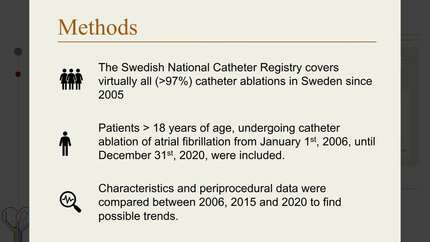
Consecutive patients (≥18 years of age) undergoing catheter ablation in Sweden between 01 January 2006 and 31 December 2015 were included in the study. Follow-up (repeat ablation and vital status) was collected through 31 December 2016. A total of 26 642 patients (57 ± 15 years, 62% men), undergoing a total of 34 428 ablation procedures were included in the study. In total, 4034 accessory pathway/Wolff–Parkinson–White syndrome (12%), 7358 AV-nodal re-entrant tachycardia (21%), 1813 atrial tachycardia (5.2%), 5481 typical atrial flutter (16%), 11 916 atrial fibrillation (AF, 35%), 2415 AV-nodal (7.0%), 581 premature ventricular contraction (PVC, 1.7%), and 964 ventricular tachycardia (VT) ablations (2.8%) were performed. Median follow-up time was 4.7 years (interquartile range 2.7–7.0). The spectrum of treated arrhythmias changed over time, with a gradual increase in AF, VT, and PVC ablation (
Catheter ablations have shifted towards more complex procedures over the past decade. Fluoroscopy time has markedly decreased and the efficacy of catheter ablation seems to improve for AF.
Contributors

Milos Kesek
Author
Anders Englund
Author
Carina Blomström-Lundqvist
Author
Lars O Karlsson
Author
Göran Kennebäck
Author
Dritan Poçi
Author
Romeo Samo-Ayou
Author
Runa Sigurjónsdóttir
Author
Michael Ringborn
Author
Csaba Herczku
Author
Jonas Carlson
Author
Espen Fengsrud
Author
Fariborz Tabrizi
Author
Niklas Höglund
Author
Stefan Lönnerholm
Author
Ole Kongstad
Author
Anders Jönsson
Author
Per Insulander
Author
You may be interested in