Peak oxygen uptake and incident coronary heart disease in a healthy population: the HUNT Fitness Study
European Heart Journal


Abstract
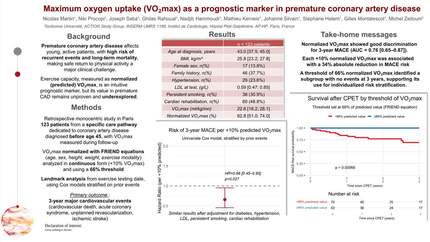
The majority of previous research on the association between cardiorespiratory fitness (CRF) and cardiovascular disease (CVD) is based on indirect assessment of CRF in clinically referred predominantly male populations. Therefore, our aim was to examine the associations between VO2peak measured by the gold-standard method of cardiopulmonary exercise testing and fatal and non-fatal coronary heart disease (CHD) in a healthy and fit population.
Data on VO2peak from 4527 adults (51% women) with no previous history of cardiovascular or lung disease, cancer, and hypertension or use of antihypertensive medications participating in a large population-based health-study (The HUNT3 Study), were linked to hospital registries and the cause of death registry. Average VO2peak was 36.0 mL/kg/min and 44.4 mL/kg/min among women and men, and 83.5% had low 10-year risk of CVD at baseline. Average follow-up was 8.8 years, and 147 participants reached the primary endpoint. Multi-adjusted Cox-regression showed 15% lower risk for the primary endpoint per one-MET (metabolic equivalent task) higher VO2peak [hazard ratio (HR) 0.85, 95% confidence interval (CI) 0.77–0.93], with similar results across sex. The highest quartile of VO2peak had 48% lower risk of event compared with the lowest quartile (multi-adjusted HR 0.52, 95% CI 0.33–0.82). Oxygen pulse and ventilatory equivalents of oxygen and carbon dioxide also showed significant predictive value for the primary endpoint.
VO2peak was strongly and inversely associated with CHD across the whole fitness continuum in a low-risk population sample. Increasing VO2peak may have substantial benefits in reducing the burden of CHD.
Contributors


You may be interested in