Contact-force-guided vs. contact-force-blinded catheter ablation of typical atrial flutter: a prospective study
EP Europace Journal


Abstract
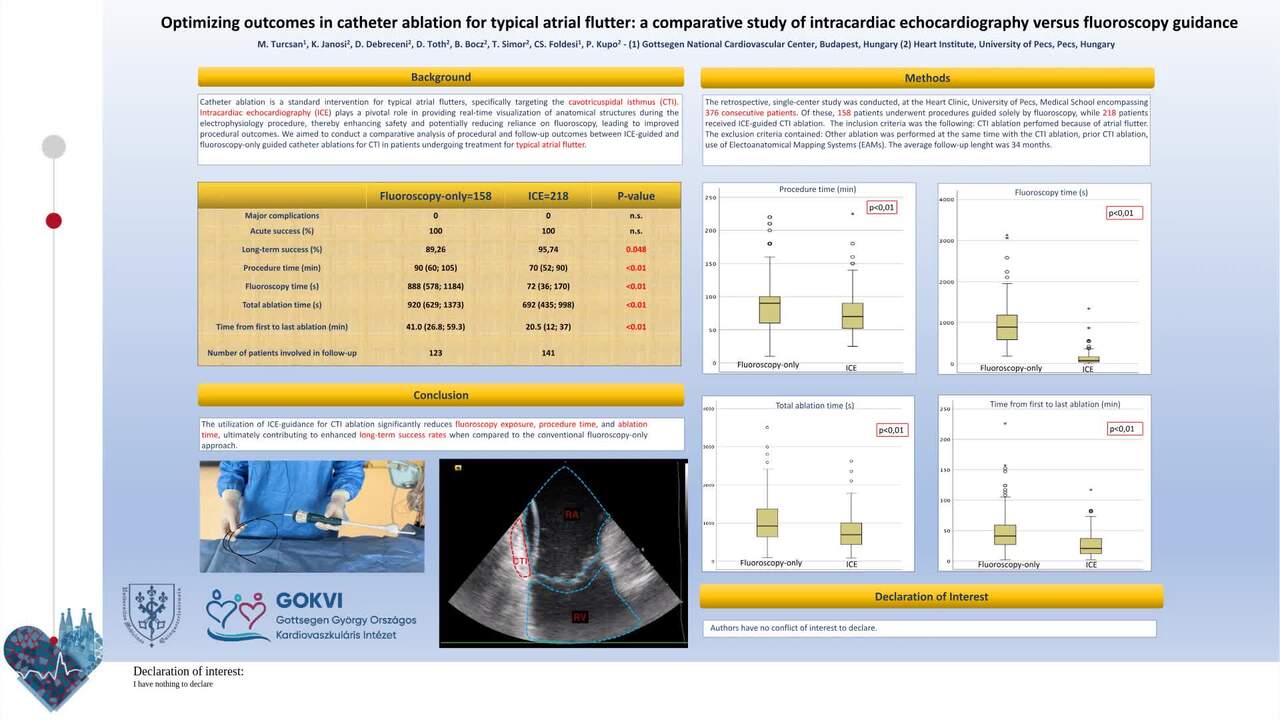
It remains unknown whether contact force (CF) sensing technology is of value for cavotricuspid isthmus (CTI) ablation. We prospectively evaluated procedural parameters and outcomes of CF-guided vs. CF-blinded CTI ablation for typical atrial flutter (AFL).
A total of 70 consecutive patients (62.5 ± 10.9 years) undergoing CTI ablation for AFL were prospectively enrolled, 35 in CF-blinded and 35 in CF-guided groups. A CF-sensing catheter (power 25–35 W) was used in all. In the CF-guided group, CF target range was 10–25 g, whereas in the CF-blinded group, the operator was blinded to CF. The isthmus was divided into anterior, middle, and posterior segments for region-specific CF analysis. The procedural endpoint of bidirectional isthmus block following a 20-min observation period was achieved in all. A trend towards lower fluoroscopy and procedure duration was observed when the CF-guided group was compared with the CF-blinded group. The total radiofrequency (RF) energy delivery time required to achieve bidirectional block was significantly lower in the CF-guided vs. CF-blinded group [10.0 min (IQR 8.3;15.1) vs. 15.9 min (IQR 9.6;24.7),
Catheter ablation of AFL guided by real-time CF assessment results in a significant reduction in total RF delivery time. Real-time CF measurements facilitate the maintenance of homogenous efficient contact all along the CTI, particularly in the anterior segment where CF is generally lower.
Contributors

Sandrine Venier
Author
Jason G. Andrade
Author
Paul Khairy
Author
Blandine Mondésert
Author
Katia Dyrda
Author
Léna Rivard
Author
Peter G. Guerra
Author
Marc Dubuc
Author
Bernard Thibault
Author
Mario Talajic
Author
Denis Roy
Author