Incidence of silent cerebral infarctions after catheter ablation of atrial fibrillation utilizing the second-generation cryoballoon
EP Europace Journal


Abstract
Pulmonary vein (PV) isolation (PVI) utilizing a cryoballoon (CB) has become one of the standard therapeutic options for atrial fibrillation (AF). However, it connotes a potential risk of cerebral ischaemic events (CIEs). This study aimed to clarify the prevalence of CIEs after PVI using second-generation CBs assessed by magnetic resonance imaging (MRI) of the brain.
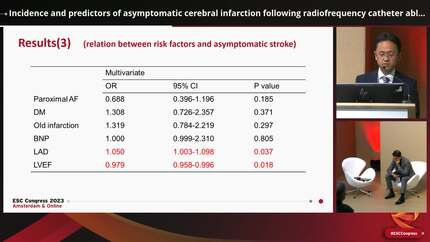
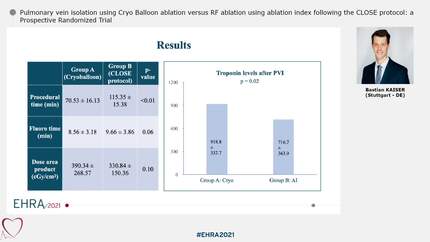
This prospective observational study consisted of 160 patients that underwent PVI with second-generation CBs for drug-refractory AF. Irrigated radiofrequency (RF) ablation for ‘touch-up’ procedures was utilized when conduction gaps between the left atrium (LA) and PVs were found after the CB application. Radiofrequency linear ablation was added in select patients. Cerebral MRI and neurological examinations were performed on the day following the ablation procedure. The MRI depicted micro-cerebral infarctions in 43 patients (26.9%, 1.49 lesions per case). All patients were free from symptomatic focal neurological deficits. Touch up ablation was required for the PVI establishment in 35 patients (21.9%). Linear ablation was performed in 59 patients (36.9%). Additional RF ablation within the LA was an independent risk of CIEs in the uni- and multivariate analyses. When the analyses were limited to patients who had undergone only CB ablation, CIEs were found in 12 of 66 patients (18.2%).
Pulmonary vein isolation utilizing second-generation CBs carries a negligible risk of symptomatic CIEs; however, it includes a comparable risk of asymptomatic CIEs as in the previous similar reports using the first-generation CB. Radiofrequency applications in addition to the CB within the LA were the only predictor of this adverse effect.
Contributors

Kaoru Okishige
Author
Toshiro Kanazawa
Author
Mitsumi Yamashita
Author
Naohiko Kawaguchi
Author
Nobutaka Kato
Author
Hideshi Aoyagi
Author
Yasuteru Yamauchi
Author
Tetsuo Sasano
Author
Kenzo Hirao
Author
You may be interested in