The role of superior vena cava in catheter ablation of long-standing persistent atrial fibrillation
EP Europace Journal


Abstract
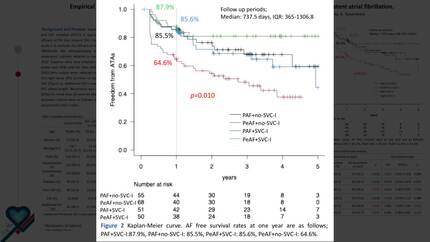
The superior vena cava (SVC) has been established as an important source of atrial fibrillation (AF). The role of SVC in long-standing persistent AF and the efficacy of empiric electrical isolation of the SVC are still unclear. The purpose of this study was to judge the role of SVC in catheter ablation of long-standing persistent AF.
A total of 102 consecutive patients with long-standing persistent AF were enrolled. All patients underwent circumferential pulmonary vein isolation, complex fractionated atrial electrograms ablation, and linear ablation during the index procedure. Superior vena cava-triggered AF and an SVC associated with the maintenance of AF were evaluated by mapping catheters during the procedure. The arrhythmogenicity of the SVC was confirmed in only 1 of the patients (0.98%). At the end of 12 months follow-up, the arrhythmia-free survival rate after a single procedure was 43.1%. After the last procedure (mean 1.47 ± 0.58 procedures), sinus rhythm was maintained in 71 (69.6%) patients, 63 of whom without antiarrhythmic drugs. The patients in AF recurrence group had higher rates of right atrium enlargement (71 vs. 34%,
The arrhythmogenic SVC is rarely detected in patients with long-standing persistent AF. Empiric SVC electrical isolation in the stepwise approach of long-standing persistent AF seems unnecessary.
Contributors

Kai Xu
Author
Yuanlong Wang
Author
Shaohui Wu
Author
Li Zhou
Author
Liang Zhao
Author
Weifeng Jiang
Author
Xiaodong Zhang
Author
You may be interested in