Pacemaker-detected severe sleep apnea predicts new-onset atrial fibrillation
EP Europace Journal


Abstract
Sleep apnea (SA) diagnosed on overnight polysomnography is a risk factor for atrial fibrillation (AF). Advanced pacemakers are now able to monitor intrathoracic impedance for automatic detection of SA events.
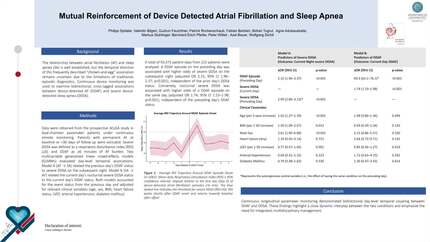
We enrolled 160 consecutive recipients of a dual-chamber pacemaker endowed with the ApneaScan algorithm (Boston Scientific). If the pacemaker-measured Respiratory Disturbance Index was ≥30 episodes per hour for at least one night during the first week after implantation, SA was defined as severe. Patients were considered to have experienced AF episodes if the device detected a cumulative AF burden ≥6 h in a day. Sixteen patients in AF at the time of implantation were excluded from our analysis. During follow-up, AF burden ≥6 h/day was documented in 35 (24%) of the patients included in the analysis and in 12 (13%) of the 96 patients with no history of AF. Severe SA was detected in 89 patients during the first week after implantation; 58 of these had no history of AF. Severe SA at the baseline was associated with a higher risk of AF both in the whole population (log-rank test, hazard ratio: 2.38; 95% CI: 1.21–4.66;
In pacemaker patients, device-diagnosed severe SA was independently associated with a higher risk of AF (≥6 h/day) and new-onset AF. In particular, severe SA on follow-up data review identified patients who were ∼2-fold more likely to experience an AF episode in the next 3 months.
Contributors

Andrea Mazza
Author
Maria Grazia Bendini
Author
Raffaele De Cristofaro
Author
Mariolina Lovecchio
Author
Sergio Valsecchi
Author

You may be interested in