Very long-term outcome following transcatheter ablation of atrial fibrillation. Are results maintained after 10 years of follow up?
EP Europace Journal


Abstract
Atrial fibrillation (AF) transcatheter ablation is a safe and effective procedure. However, outcome over 10 years of follow-up has never been reported. The aim of this study is to assess outcome, describe predictors of recurrences, and report on quality of life (QoL) the decade after an AF ablation.
Patients referred for AF ablation in a single high volume centre from June 2004 to June 2006 were enrolled and followed in a prospective fashion by yearly clinical assessment and Holter monitoring. Among 255 patients (42.7% paroxysmal AF, 77% males, after a follow-up of 125 ± 7 months), 132 (52%) were arrhythmia-free including (58, 32% after a single procedure) while 27 (10%) progressed to permanent AF. At multivariate analysis, a greater left atrium antero-posterior diameter (HR 1.05 95% CI 1.02–1.09,
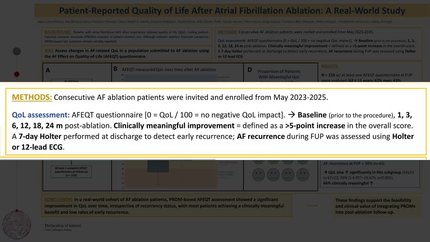
The outcome of AF ablation over more than 10 years is characterized by a low incidence of progression towards permanent AF. Greater LA anteroposterior diameter related to arrhythmic recurrences, while blood pressure, BMI, and fasting blood glucose control emerged as predictors of sinus rhythm maintenance. Eventually, QoL improved significantly over the follow-up.
Contributors

Marco Scaglione
Author
Alberto Battaglia
Author
Mario Matta
Author
Cristina Gallo
Author
Michela Galatà
Author
Domenico Caponi
Author
Paolo Di Donna
Author
Matteo Anselmino
Author
You may be interested in