Modified Technique to Control the Eutachian Valve During Transcatheter Closure of Atrial Septal Defect/Patent Foramen Ovale
European Heart Journal Supplements


Abstract
to describe an approach to perform safe transcatheter closure of Atrial Septal Defect (ASD)/Patent Foramen Ovale (PFO) associated with large redundant Eustachian Valve.
Transcatheter device closure of ASD/PFO is feasible in a great majority of patients. However, the presence of a huge mobile Eustachian Valve can compromise device placement.
Six patients (3 PFO and 3 ASD patients) with a huge redundant Eustachian valve were included. Two patients had PFO with long tunnel and were closed with Occlutech FigullaFlex II PFO occluders sized 23/25 and 27/30 respectively. The other PFO patient had an associated atrial septal aneurysm (ASA) and was closed with a 25 mm Amplatzer Multi-Fenestrated Septal Occluder “cribriform” device (St. Jude Medical – Abbott Vascular). The three ASDs were closed by regular ASD occluders (2 Flex II ASD Occluders sized 30 and 33 mm and 1 Amplatzer ASD Occluder sized 24 mm).
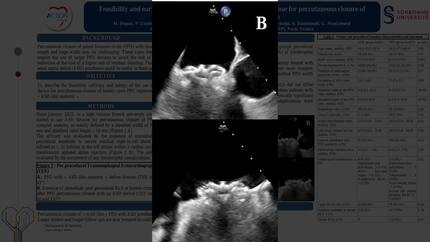
Eustachian valve was successfully held with a steerable ablation catheter to deflect it against the lateral right atrial wall, keeping it away from the inter-atrial septum to prevent its entrapment or interference with the cable, the sheath or the device.
All ASDs/PFOs have been successfully closed with no complications with free inferior vena cava (IVC) flow, with no residual inter-atrial shunt and the eustachian valve is not interfering with the device.
Safe percutaneous ASD/PFO closure can be achieved with proper control of a large redundant Eustachian valve.
Contributors

You may be interested in