C40. Early Repolarization Syndrome: The Dangerous One
European Heart Journal Supplements


Abstract
Early repolarization pattern (ERP) in electrocardiogram (ECG) was thought to be benign in nature. However, for the last 2 decades, several cases reported sudden cardiac deaths (SCD) in patient with ERP.
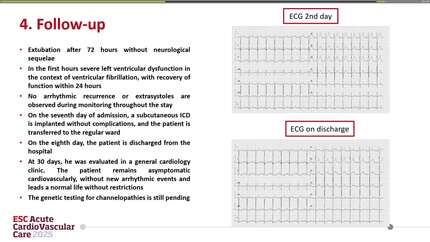
A 40-year-old male with a history of several syncope episodes. The latest episode in 2019 at 5 am, a brief convulsion happened before the patient went unconscious. In emergency room, he had another convulsion with a witnessed ventricular fibrillation. After resuscitation and defibrillation, the patient awoke, and ECG was recorded showing ST-segment elevation at V2-3 which suspected to be a Brugada syndrome (BrS).
Patient then referred to Sardjito hospital for echocardiography and treadmill test, and the results were within normal limit. Coronary CT Scan showed a non-significant lesion at LAD. Holter examination showed during sleeping, J-wave elevation appeared at the rate of 50 bpm. Meanwhile, during exercise, J-wave disappeared at the rate of 135 bpm. The patient was diagnosed as early repolarization syndrome (ERS) and managed with implantable cardioverter-defibrillator (ICD) implantation.
Patient with ERP who suffers syncope/cardiac arrest is classified as an ERS. Particular clinical findings such as history of cardiac arrest, convulsion, apnea, and ECG findings such as short coupled premature ventricular contraction, dynamic J-wave changes, widespread J-wave are associated with a higher chance for ventricular arrhythmia. Due to its similar nature in ECG morphology and its pathophysiology, ERS and BrS are classified into J-wave syndrome.
Contributors

You may be interested in