Analysis of the heart rate variability during cryoballoon ablation of atrial fibrillation
EP Europace Journal


Abstract
Vagal responses such as marked bradycardia or a rapid blood pressure decrease are often observed during pulmonary vein (PV) isolation of atrial fibrillation (AF) using a cryoballoon (CB). However, the relationship between the marked vagal response and change in the heart rate variability (HRV) as a marker of the autonomic tone is not well understood.
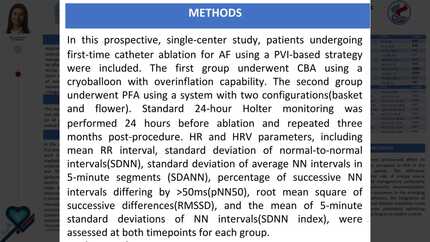
Fifty-four paroxysmal AF patients underwent CB ablation. The CB ablation was started from the right sided PVs in 25 patients (R group) and left sided PVs in 29 (L group). The HRV and haemodynamic status during the procedure were analysed. A vagal response was observed in 16 L group patients (61.5%) during the ablation of the different PVs (RSPV:1, RIPV:5, LSPV:15, LIPV:5), while it was observed in only 2 R group patients (9.5%) (RSPV:0, RIPV:0, LSPV:1, LIPV:1) (
A marked increase in the HRV parameters was observed just after the CB ablation. An initial CB ablation of the right PVs decreased the change in the autonomic tone during the right PV ablation and subsequent left PV ablation. It prevented an excessive vagal response during the CB ablation and might be a safe procedure.
Contributors

Hitoshi Mori
Author
Yoshifumi Ikeda
Author
Koji Goto
Author
Sayaka Tanaka
Author
So Asano
Author
Yuichiro Shiki
Author
Takahiko Nagase
Author
Shiro Iwanaga
Author
Shigeyuki Nishimura
Author
Toshihiro Muramatsu
Author
Kazuo Matsumoto
Author
You may be interested in