Delta of the local ventriculo-atrial intervals at the septal location to differentiate tachycardia using septal accessory pathways from atypical atrioventricular nodal re-entry
EP Europace Journal


Abstract
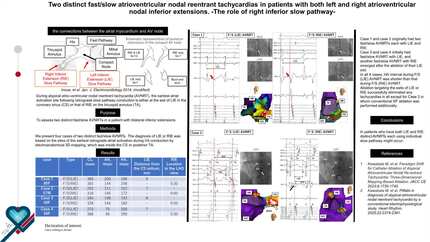
Tachycardia mediated by septal accessory pathways (AP) and atypical atrioventricular nodal re-entry (AVNRT) require careful electrophysiologic evaluation for differential diagnosis. We aim to describe the differential behaviour of local ventriculo-atrial (VA) intervals which predicts the tachycardia mechanism.
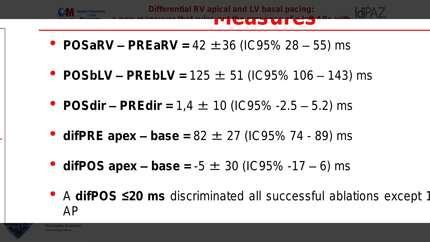
The local VA intervals at the para-Hisian septum were measured under three different situations: (i) tachycardia; (ii) sustained entrainment from the right ventricular apex (RVA); and (iii) continuous pacing from the RVA during sinus rhythm. Differences were computed as follows: Δ-VAentr = VA during entrainment − VA during tachycardia; and Δ-VApac = VA while pacing during sinus rhythm − VA during tachycardia. In contrast to AVNRT, we hypothesized that an invariable retrograde conduction through the septal AP will keep the result of the subtractions close to 0 ms in cases of ortodromic atrioventricular re-entrant tachycardia (AVRT). We analysed 55 atypical AVNRT (45% posterior type) and 82 AVRT (10 anteroseptal, 18 para-Hisian, 12 mid-septal, and 42 posteroseptal). Δ-VAentr was longer for AVNRT (98.5 ± 40.3 ms) compared with septal AP (−5.7 ± 19.3 ms;
Delta of the local VA intervals enables distinction between atypical AVNRT and AVRT mediated by septal AP.
Contributors

David Calvo
Author
Diego Pérez
Author
José Rubín
Author
Daniel García
Author
Pablo Ávila
Author
F Javier García-Fernández
Author
Marta Pachón
Author
Loreto Bravo
Author
Jesús Hernández
Author
Ángel L Miracle
Author
Irene Valverde
Author
Mar Gozalez-Vasserot
Author
Miguel Ángel Árias
Author
Javier Jimenez-Candíl
Author
César Morís
Author