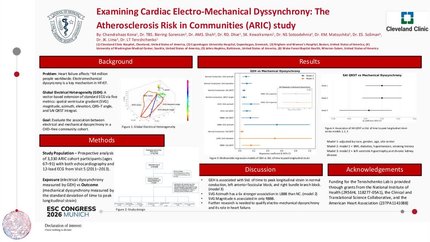
Global electrical heterogeneity as a predictor of cardiovascular mortality in men and women
EP Europace Journal


Abstract
The aim of this study was to investigate the contribution of depolarization and repolarization abnormalities, specially abnormalities in global electrical heterogeneity of heart in cardiovascular disease (CVD) and all-cause mortality.
Eight hundred and forty men and 911 women, average age of 63 years participated in this study with average follow-up was 14 years. Six electrocardiogram/vector electrocardiogram (ECG/VECG) markers QRS-duration, QTc-interval, QRST-angle, sum of absolute QRST integral (SAI QRST), T-wave roundness, and TV1-amplitude were estimated from VECG measurements. Hazard ratios (HRs) for CVD events (164 deaths) and all-cause mortality (383 deaths) for ECG parameters were calculated. Electrocardiogram or vector electrocardiogram parameter models adjusted for risk clinical factors showed that strongest predictors for CVD mortality were QRST-angle (HR 3.44, 95% confidence interval 2.12–5.36), QTc-interval (2.72, 1.73–4.29), and T-wave roundness (2.09, 1.26–3.46) among men. The strongest ECG/VECG parameters for CVD death were QRST-angle (2.47, 1.37–4.45), SAI QRST (2.37, 1.23–4.6), and QTc-interval (2.15, 1.16–4.01) among female participants. Multivariable adjusted models revealed that strongest independent ECG predictors for CVD death were QRST-angle, QTc-interval, resting heart rate, and T-roundness for men, QRST-angle and SAI QRST for women. QRST-angle, QTc-interval, resting heart rate, and T-roundness were associated with all-cause mortality in male population, although none of the ECG/VECG parameters predicted all-cause mortality among women.
Characteristics of global electrical heterogeneity QRST-angle and QTc-interval in men and QRST-angle and SAI QRST among females were strong and independent risk markers for cardiovascular mortality. These parameters provide new additional ECG tools for cardiovascular risk stratification.
Contributors

You may be interested in