Updated systematic review and meta-analysis of the impact of contact force sensing on the safety and efficacy of atrial fibrillation ablation: discrepancy between observational studies and randomized control trial data
EP Europace Journal


Abstract
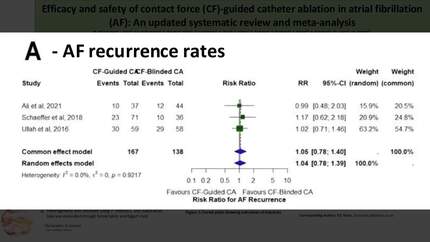
Despite widespread adoption of contact force (CF) sensing technology in atrial fibrillation (AF) ablation, randomized data suggests lack of improvement in clinical outcomes. We aimed to assess the safety and efficacy of CF-guided vs. non CF-guided AF ablation.
Electronic databases were searched for randomized controlled trials (RCTs) and controlled observational studies (OS) comparing outcomes of AF ablation performed with vs. without CF guidance. The primary efficacy endpoint was freedom from AF at follow-up. The primary safety endpoint was major peri-procedural complications. Secondary endpoints included procedural, fluoroscopy, and ablation duration. Subgroup analyses were performed by AF type and study design. Nine RCTs (
Meta-analysis of randomized data demonstrated that CF guidance does not improve the safety or efficacy of AF ablation, despite initial observational data showing dramatic improvement. Rigorous evaluation in randomized trials is needed before widespread adoption of new technologies.
Contributors

You may be interested in