Temporal trends in bleeding events in acute myocardial infarction: insights from the SWEDEHEART registry

European Heart Journal

1 September 2019
Organised by: Logo
ESC Journals CORONARY ARTERY DISEASE, ACUTE CORONARY SYNDROMES, ACUTE CARDIAC CARE Acute Coronary Syndromes PREVENTIVE CARDIOLOGY Risk Factors and Prevention

Abstract

AbstractAims

To describe the time trends of in-hospital and out-of-hospital bleeding parallel to the development of new treatments and ischaemic outcomes over the last 20 years in a nationwide myocardial infarction (MI) population.

Methods and results

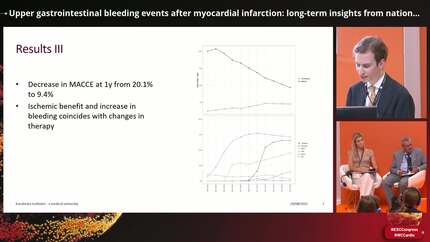
Patients with acute MI (n = 371 431) enrolled in the SWEDEHEART registry from 1995 until May 2018 were selected and evaluated for in-hospital bleeding and out-of-hospital bleeding events at 1 year. In-hospital bleeding increased from 0.5% to a peak at 2% 2005/2006 and thereafter slightly decreased to a new plateau around 1.3% by the end of the study period. Out-of-hospital bleeding increased in a stepwise fashion from 2.5% to 3.5 % in the middle of the study period and to 4.8% at the end of the study period. The increase in both in-hospital and out-of-hospital bleeding was parallel to increasing use of invasive strategy and adjunctive antithrombotic treatment, dual antiplatelet therapy (DAPT), and potent DAPT, while the decrease in in-hospital bleeding from 2007 to 2010 was parallel to implementation of bleeding avoidance strategies. In-hospital re-infarction decreased from 2.8% to 0.6% and out-of-hospital MI decreased from 12.6% to 7.1%. The composite out-of-hospital MI, cardiovascular death, and stroke decreased in a similar fashion from 18.4% to 9.1%.

Conclusion

During the last 20 years, the introduction of invasive and more intense antithrombotic treatment has been associated with an increase in bleeding events but concomitant there has been a substantial greater reduction of ischaemic events including improved survival.

Contributors

Moa Simonsson
Moa Simonsson

Author

Karolinska Institute Stockholm , Sweden

David Erlinge
David Erlinge

Author

Skane University Hospital Lund , Sweden

Robin Hofmann
Robin Hofmann

Author

Karolinska Institute Stockholm , Sweden

Annica Ravn-Fischer
Annica Ravn-Fischer

Author

Sahlgrenska University Hospital Gothenburg , Sweden