Oral anticoagulants in patients with atrial fibrillation at low stroke risk: a multicentre observational study
European Heart Journal


Abstract
There is currently no consensus on whether atrial fibrillation (AF) patients at low risk for stroke (one non-sex-related CHA2DS2-VASc point) should be treated with an oral anticoagulant.
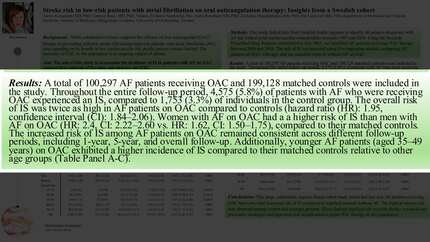
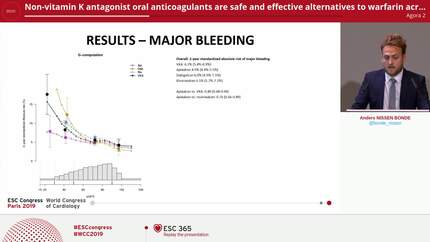
We conducted a multi-country cohort study in Sweden, Denmark, Norway, and Scotland. In total, 59 076 patients diagnosed with AF at low stroke risk were included. We assessed the rates of stroke or major bleeding during treatment with a non-vitamin K antagonist oral anticoagulant (NOAC), a vitamin K antagonist (VKA), or no treatment, using inverse probability of treatment weighted (IPTW) Cox regression. In untreated patients, the rate for ischaemic stroke was 0.70 per 100 person-years and the rate for a bleed was also 0.70 per 100 person-years. Comparing NOAC with no treatment, the stroke rate was lower [hazard ratio (HR) 0.72; 95% confidence interval (CI) 0.56–0.94], and the rate for intracranial haemorrhage (ICH) was not increased (HR 0.84; 95% CI 0.54–1.30). Comparing VKA with no treatment, the rate for stroke tended to be lower (HR 0.81; 95% CI 0.59–1.09), and the rate for ICH tended to be higher during VKA treatment (HR 1.37; 95% CI 0.88–2.14). Comparing NOAC with VKA treatment, the rate for stroke was similar (HR 0.92; 95% CI 0.70–1.22), but the rate for ICH was lower during NOAC treatment (HR 0.63; 95% CI 0.42–0.94).
These observational data suggest that NOAC treatment may be associated with a positive net clinical benefit compared with no treatment or VKA treatment in patients at low stroke risk, a question that can be tested through a randomized controlled trial.
Contributors

Joris J Komen
Author
Anton Pottegård
Author
Aukje K Mantel-Teeuwisse
Author
Tomas Forslund
Author
Paul Hjemdahl
Author
Björn Wettermark
Author
Jesper Hallas
Author
Morten Olesen
Author
Marion Bennie
Author
Tanja Mueller
Author
Raymond Carragher
Author
Øystein Karlstad
Author
Lars J Kjerpeseth
Author
Olaf H Klungel
Author
You may be interested in