741
Pharmacological inhibition of the acetylcholine-regulated potassium channel (IK,ACh) prevents atrial arrhythmogenic changes in a rat model for obstructive sleep apnea
EP Europace Journal


Abstract
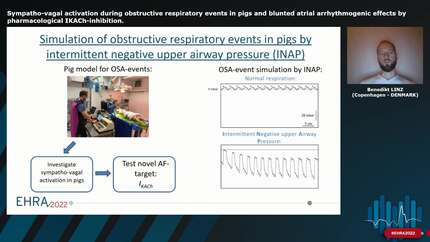
In obstructive sleep apnea (OSA), intermittent hypoxemia and intrathoracic pressure fluctuations may increase vagal tone, resulting in an increased acetylcholine-regulated potassium current (IK,ACh). Here we elucidated acute atrial electrophysiological effects of obstructive respiratory events simulated by intermittent negative upper airway pressure (INAP) and the role of atrial IKACh activation.
In sedated spontaneously breathing rats (2% isoflurane), either IK,ACh-inhibitor (XAF-1407: 1mg/kg) or a buffer-based vehicle was perfused (Control). INAP was applied non-invasively by a negative pressure device 14 times throughout 70 minutes. Simulated apneas were maintained for one minute with a four minute resting period. Atrial effective refractory period (AERP), inducible atrial fibrillation (AF)-durations and atrial activation time were acquired by a programmed atrial pacing protocol before, during and after applied INAP throughout the study.
During single INAP applications atrial activation times prolonged transiently in both groups (Control: INAP vs. pre-INAP p = 0.034; XAF-1407: INAP vs. pre-INAP p = 0.039). In control-rats, seventy minutes of repetitive INAP prolonged P-wave duration (+10.8 ± 2.7% vs. baseline, p = 0.008) and decreased AERP by 14.6 ± 3.1% (vs. baseline p = 0.001). AERP shortening correlated with the cumulative pressure applied per body weight (Pearson r= -0.773; p= 0.025). XAF-1407 could prevent P-wave prolongation and AERP shortening. Inducible AF-durations (CTR 0.94 ± 0.34s vs. XAF-1407 0.1 ± 0.09s p = 0.049) were shorter in XAF-1407 treated rats. Drops in oxygen saturation or applied INAP were comparable in control and XAF-1407 rats.
Short-term simulated OSA is associated with AF-related arrhythmogenic changes, which could be prevented by pharmacological IK,ACh inhibition. Moreover, the cumulative negative airway pressure applied determined aERP shortening and may represent a target for OSA treatment. These findings have important implications for the antiarrhythmic management of AF patients with OSA.
Contributors

B Linz
Author
K Rombouts
Author
A H Thostrup
Author
M Hohl
Author
K Wirth
Author
D Linz
Author
T Jespersen
Author
You may be interested in