P1000
Aetiology and efficacy of atrial fibrillation ablation in young adults
EP Europace Journal


Abstract
Little is known regarding the aetiology or outcome of atrial fibrillation (AF) occurring in young adults. This retrospective analysis was performed to explore the demographics and efficacy of AF ablation in this population.
Patients were included who had undergone ≥1 AF ablation under the age of 40 between 2006-2018. Recurrence was defined as return of either documented AF or previous symptoms for >30s following a 3-month blanking period. Initial exploratory co-variates were included in a univariate analysis and those terms with P-value of <0.1 were then used to generate a Cox proportional-hazards multivariate model.
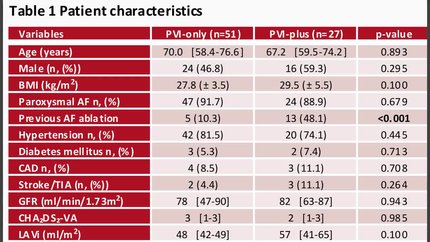
124 patients (33.6 ± 4.7 yrs, 77% men), initially presenting with paroxysmal AF (pAF; n = 97) or persistent AF (n = 27), underwent 175 AF ablation procedures. 22.6% (n = 28) also had atrial flutter. Time from symptom onset to first ablation was 50.7 ± 46.2 months. Relevant cardiovascular-related demographics were analysed: hypertension in 8.9% (n = 11); diabetes in 1.6% (n = 2); positive family history of AF in 12.9% (n = 16); and family history of sudden cardiac death in 2.4% (n = 3). Mean CHA2DS2-VASc score was 0.35. Of those patients with documented echocardiogram imaging (n = 91), 26.4% (n = 24) had LA dilatation and 6.6% (n = 6) had LV dysfunction. Patients with LA dilatation underwent more ablations (2.3 ± 0.3) compared to controls (1.5 ± 0.1; p < 0.001).
Ablation strategy was pulmonary vein isolation (PVI) only in 67.2% (n = 119), with additional ablation in the remaining: roof line in 18.9% (n = 33); cavotricuspid isthmus line in 13.1% (n = 23); mitral isthmus line in 2.3% (n = 4); superior vena cava isolation in 2.3% (n = 4); complex fractionated atrial electrograms in 14.9% (n = 26). Mean procedure time was 155 ± 41 min, mean ablation time was 1657 ± 991 s and mean fluoroscopy time was 32.6 ± 23.4 min. General anaesthesia was used in 43.4% (n = 76). Complications included femoral haematoma (n = 2), tamponade (n = 1) and pulmonary vein stenosis (n = 2).
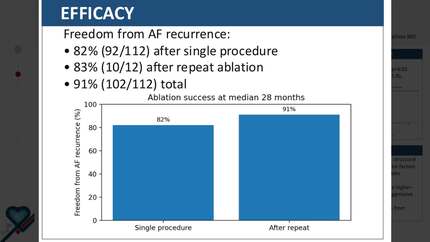
90 days of follow-up was available for 137 procedures performed for pAF (n = 105) and persistent AF (n = 32). For pAF, overall recurrence was 61.9% for first ablations and 62.9% overall. Recurrence was 56.3% for persistent AF.
male gender (hazard ratio (HR) 2.3, 95% confidence interval (CI): 1.2-4.4, p = 0.011), hypertension (HR 0.5, CI: 0.2-1.1, p = 0.067), family history of sudden cardiac death (HR 6.8, CI: 1.6-29.0 , p = 0.010) and enlarged LA size (HR 2.2, CI: 1.3-3.6, p = 0.003). In multivariate analysis, the only significant predictor of poor outcome was enlarged LA size (HR 2.0, 95% CI: 1.2-3.5, p = 0.011).
Young patients with AF may have structurally abnormal hearts, and therefore do not only present with lone AF. LA size may be used as a predictor for success. Surveillance imaging may be useful to detect future structural change, which will be the subject of future prospective studies.
Abstract Figure. AF ablation recurrence in young adults
Contributors

R Zhang
Author
I T Fazmin
Author
A Porto
Author
K Divulwewa
Author
A Reddy
Author
B Di Nubila
Author
M F Mausa
Author
G Mellor
Author
S Agarwal
Author
D Begley
Author
S Fynn
Author
A Grace
Author
P Heck
Author
M Virdee
Author
C A Martin
Author
You may be interested in