Clinical validation of an artificial intelligence-assisted algorithm for automated quantification of left ventricular ejection fraction in real time by a novel handheld ultrasound device
European Heart Journal - Digital Health


Abstract
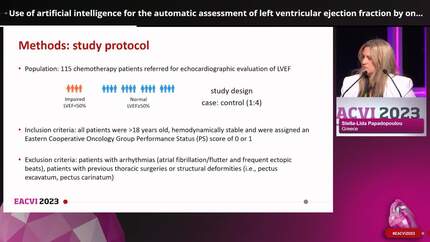
We sought to evaluate the reliability and diagnostic accuracy of a novel handheld ultrasound device (HUD) with artificial intelligence (AI) assisted algorithm to automatically calculate ejection fraction (autoEF) in a real-world patient population.
We studied 100 consecutive patients (57 ± 15 years old, 61% male), including 38 with abnormal left ventricular (LV) function [LV ejection fraction (LVEF) < 50%]. The autoEF results acquired using the HUD were independently compared with manually traced biplane Simpson’s rule measurements on cart-based systems to assess method agreement using intra-class correlation coefficient (ICC), linear regression analysis, and Bland–Altman analysis. The diagnostic accuracy for the detection of LVEF <50% was also calculated. Test–retest reliability of measured EF by the HUD was assessed by calculating the ICC and the minimal detectable change (MDC). The ICC, linear regression analysis, and Bland–Altman analysis revealed good agreement between autoEF and reference manual EF (ICC = 0.85;
Use of a novel HUD with AI-enabled capabilities provided similar LVEF results with those derived by manual biplane Simpson’s method on cart-based systems and shows clinical potential.
Contributors


Vasileios Sachpekidis
Author
Vasiliki Kantartzi
Author
Ioannis Styliadis
Author
Petros Nihoyannopoulos
Author
You may be interested in