Outcomes associated with non-recommended dosing of rivaroxaban: results from the XANTUS study
European Heart Journal - Cardiovascular Pharmacotherapy


Abstract
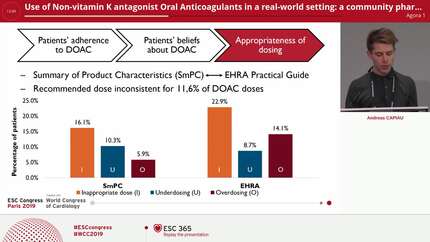
In Europe, the approved rivaroxaban dose for stroke prevention in patients with atrial fibrillation (AF) is 20 mg once daily (o.d.), with 15 mg o.d. recommended in patients with creatinine clearance (CrCl) 15–49 mL/min. Non-recommended doses are prescribed in real-world practice. This analysis of the XANTUS study assessed outcomes associated with non-recommended dosing and patient characteristics that may have impacted dose choice.
Baseline characteristics and 1 year outcomes were compared in 4464/6784 patients with known CrCl, receiving recommended or non-recommended rivaroxaban doses; 3608 (80.8%) patients received recommended doses (mean CHADS2 score 1.9) and 856 (19.2%) non-recommended doses (mean CHADS2 score 2.5). Incidence rate (events/100 patient-years) for the composite of treatment-emergent adjudicated major bleeding, stroke/systemic embolism, and death was 7.5 [95% confidence interval (CI) 5.7–9.8] and 4.8 (95% CI 4.1–5.7) with non-recommended and recommended doses, respectively [hazard ratio (HR) 1.55, 95% CI 1.2–2.1;
Non-recommended rivaroxaban dosing was associated with less favourable outcomes, possibly due to baseline characteristics, in addition to renal function, that may also affect physicians’ dosing decisions.
Clinicaltrials.gov: NCT01606995.
Contributors

Pierre Amarenco
Author
Sylvia Haas
Author
Susanne Hess
Author
Paulus Kirchhof
Author
Marc Lambelet
Author
Miriam Bach
Author
Alexander G G Turpie
Author
A John Camm
Author
You may be interested in