All-cause mortality, stroke, and bleeding in patients with atrial fibrillation and valvular heart disease
European Heart Journal - Cardiovascular Pharmacotherapy


Abstract
To compare the risk of all-cause mortality, stroke, and bleeding in patients with atrial fibrillation (AF) and valvular heart disease (VHD) treated with vitamin K antagonist (VKA) or factor Xa-inhibitors (FXa-I; rivaroxaban and apixaban).
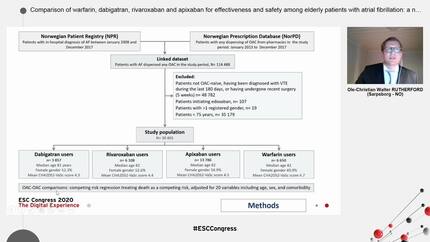
We cross-linked data from Danish nationwide registries identifying patients with AF and VHD (aortic stenosis/insufficiency, mitral insufficiency, bioprosthetic heart valves, mitral-, and aortic valve repair) initiating VKA or FXa-I between January 2014 and June 2017. Outcomes were all-cause mortality, stroke, and bleeding. Using cause-specific Cox regression, we reported the standardized absolute 2-year risk of the outcomes and absolute risk differences (ARD). We identified 1115 (41.7%), 620 (23.1%), and 942 (35.2%) patients initiating treatment with VKA, rivaroxaban, and apixaban, respectively. The standardized absolute risk (95% confidence interval) of all-cause mortality associated with VKA treatment was 34.1% (30.4–37.8%) with corresponding ARD for FXa-I of −2.7% (−6.7% to 1.4%). The standardized absolute risk of stroke for VKA was 3.8% (2.2–5.4%) with corresponding ARD for FXa-I of –0.1% (−2.0% to 1.8%). The standardized risk of bleeding for VKA was 10.4% (7.2–12.9%) with corresponding ARD for FXa-I of –2.0% (−5.1% to 1.1%). The risk of bleeding was significantly reduced in subgroup analyses of apixaban compared with VKA [ARD: −3.9% (−7.0% to −0.9%)] and rivaroxaban [ARD: −5.6% (−9.5% to −1.7%)].
In this nationwide cohort study, there were no significant differences in the risks of all-cause mortality, stroke, and bleeding in patients with AF and VHD treated with VKA compared with FXa-I.
Contributors

Jonas Bjerring Olesen
Author

Caroline Sindet-Pedersen
Author
Laila Staerk
Author

Thomas Alexander Gerds
Author
Christian Torp-Pedersen
Author
Gunnar H Gislason
Author
You may be interested in