Incidence and impact of acute cardiorenal syndrome
European Journal of Cardiovascular Nursing


Abstract
Type of funding sources: None.
Acute (or type 1) cardio-renal syndrome (ACRS) is defined as the acute kidney injury in patients hospitalized for acute heart failure (HF), which often is associated to a complex and complicated clinical course. In addition, renal failure is a strong predictor of long-term adverse events in patients with acute heart failure (HF).
To investigate the impact of ACRS, what factors are related to its occurrence, and how it affects the outcome of patients hospitalized with acute HF.
We studied consecutive patients hospitalized with acute HF from January 2019 to December 2020. Renal function as well as other biomarkers were recorded and monitored during hospitalization, and correlated with various clinical characteristics, risk factors and patient outcome.
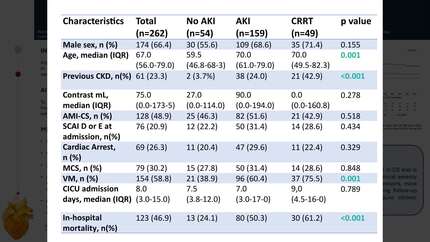
The sample consists of 612 patients, mean age 77 ± 12 years, 63% men with average duration of hospitalization 6 ± 4 days. A total of 37 deaths (6%) were observed. ACRS was found in 141 patients (23%) and independent prognostic factors for its occurrence were ischemic cardiomyopathy, age, prolonged hospitalization, use of aldosterone antagonists and high CRP upon admission. The incidence of ACRS during hospitalization was an independent prognostic factor of death (r = 0.15, p = 0.02) and anemia (r = 0.24, p = 0.04), while the outcome of death was more common in patients with ACRS - but without statistical significance - compared to patients without ACRS.
Deterioration of renal function in acute HF is associated with anemia and death. Factors such as ischemic cardiomyopathy, age, length of hospital stay seem to play a role in the onset of ACRS and should be taken into account in these patients, to prevent negative outcomes.
Contributors

You may be interested in