Efficacy and safety of dual-pathway inhibition in patients with cardiovascular disease: a meta-analysis of 49 802 patients from 7 randomized trials
European Heart Journal - Cardiovascular Pharmacotherapy


Abstract
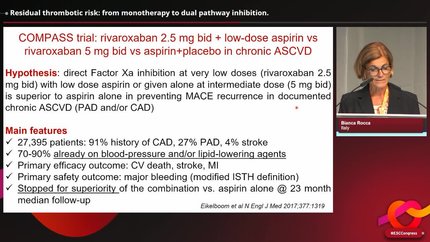
Low-dose (LD) direct oral anticoagulants (DOACs) in adjunct to antiplatelet therapy, known as dual-pathway inhibition (DPI), have been tested to prevent ischaemic events in patients with cardiovascular disease (CVD). We conducted a systematic review and meta-analysis to determine the overall safety and efficacy of LD DOACs vs placebo on a background of antiplatelet therapy.
All randomized controlled trials (RCTs) comparing LD DOAC (defined as a dosage below the lowest approved for stroke prevention) vs placebo among patients with CVD receiving single or dual antiplatelet therapy (DAPT) in at least 50% of the population and followed for at least 6 months, were included. Incidence rate ratios (IRRs) with 95% confidence intervals (CIs) were used to overcome different follow-up durations across trials. The primary efficacy endpoint was major adverse cardiovascular events (MACE) and the primary safety endpoint major bleeding. A pre-specified subgroup analysis was performed for different DOAC-dose regimens. A total of 49 802 patients from 7 RCTs were included. Low-dose DOACs vs placebo were associated with significant reductions in MACE (IRR 0.85, 95% CI 0.78–0.91, number needed to treat, NNT, 86) and myocardial infarction (IRR 0.86, 95% CI 0.78–0.95, NNT 355) and significant increases of major (IRR 2.05, 95% CI 1.50–2.80, number needed to harm, NNH, 89) or all bleeding (IRR 1.82, 95% CI 1.49–2.22, NNH 23). Cardiovascular death (IRR 0.90, 95% CI 0.79–1.03, NNT 784), intracranial (IRR 1.18, 95% CI 0.71–1.96, NNH 1810), and fatal bleeding (IRR 1.13, 95% CI 0.76–1.69, NNH 3170) did not differ significantly between strategies. Non-significant reductions of all-cause death (IRR 0.90, 95% CI 0.80–1.01, NNT 821) and stroke (IRR 0.73, 95% CI 0.53–1.01, NNT 315) favoured LD DOACs. Meta-regression analyses showed a significant interaction between percentage of DAPT use and increased risk of major bleeding (
In patients with CVD, LD DOAC vs placebo on a background of antiplatelet therapy, reduced ischaemic events at the expense of increased major and all bleeding, but without significantly increasing intracranial or fatal bleeds, while the reduction of cardiovascular or total mortality and stroke was not statistically significant. A DPI with very LD DOAC (i.e. rivaroxaban 2.5 mg twice daily) appeared particularly advantageous, especially when combined with a single antiplatelet agent and used among patients at high ischaemic and low bleeding risk.
This study is registered in PROSPERO (CRD42021232744).
Contributors

Mattia Galli
Author
Davide Capodanno
Author
Stefano Benenati
Author
Domenico D’Amario
Author
Filippo Crea
Author
Felicita Andreotti
Author

Dominick J Angiolillo
Author
University of Florida College of Medicine – Jacksonville Jacksonville , United States of America
You may be interested in