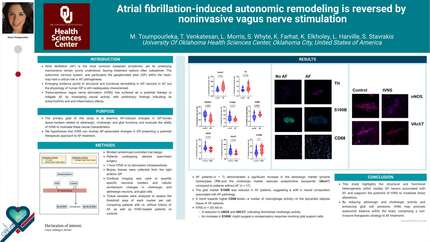
Immunohistochemical characteristics of local sites that trigger atrial arrhythmias in response to high-frequency stimulation
EP Europace Journal


Abstract
The response to high frequency stimulation (HFS) is used to locate putative sites of ganglionated plexuses (GPs), which are implicated in triggering atrial fibrillation (AF). To identify topological and immunohistochemical characteristics of presumed GP sites functionally identified by HFS.
Sixty-three atrial sites were tested with HFS in four Langendorff-perfused porcine hearts. A 3.5 mm tip quadripolar ablation catheter was used to stimulate and deliver HFS to the left and right atrial epicardium, within the local atrial refractory period. Tissue samples from sites triggering atrial ectopy/AF (ET) sites and non-ET sites were stained with choline acetyltransferase (ChAT) and tyrosine hydroxylase (TH), for quantification of parasympathetic and sympathetic nerves, respectively. The average cross-sectional area (CSA) of nerves was also calculated. Histomorphometry of six ET sites (9.5%) identified by HFS evoking at least a single atrial ectopic was compared with non-ET sites. All ET sites contained ChAT-immunoreactive (ChAT-IR) and/or TH-immunoreactive nerves (TH-IR). Nerve density was greater in ET sites compared to non-ET sites (nerves/cm2: 162.3 ± 110.9 vs. 69.65 ± 72.48;
ET sites identified by HFS contained a higher density of smaller nerves than non-ET sites. The majority of these nerves were within the atrial myocardium. This has important clinical implications for devising an effective therapeutic strategy for targeting autonomic triggers of AF.
Contributors

Min-young Kim
Author
James Nesbitt
Author
Simos Koutsoftidis
Author
Joseph Brook
Author
David S Pitcher
Author
Chris D Cantwell
Author
Balvinder Handa
Author
Catherine Jenkins
Author
Charles Houston
Author
Stephen Rothery
Author
Anand Jothidasan
Author
Justin Perkins
Author
Poppy Bristow
Author
Nick W F Linton
Author
Emm Drakakis
Author
Nicholas S Peters
Author
Rasheda A Chowdhury
Author
Prapa Kanagaratnam
Author

Fu Siong Ng
Author
Imperial College London London , United Kingdom of Great Britain & Northern Ireland
You may be interested in