Optimization of anti-tachycardia pacing efficacy through scar-specific delivery and minimization of re-initiation: a virtual study on a cohort of infarcted porcine hearts
EP Europace Journal


Abstract
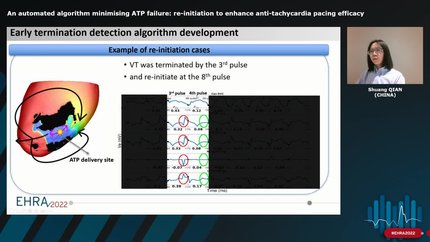
Anti-tachycardia pacing (ATP) is a reliable electrotherapy to painlessly terminate ventricular tachycardia (VT). However, ATP is often ineffective, particularly for fast VTs. The efficacy may be enhanced by optimized delivery closer to the re-entrant circuit driving the VT. This study aims to compare ATP efficacy for different delivery locations with respect to the re-entrant circuit, and further optimize ATP by minimizing failure through re-initiation.
Seventy-three sustained VTs were induced in a cohort of seven infarcted porcine ventricular computational models, largely dominated by a single re-entrant pathway. The efficacy of burst ATP delivered from three locations proximal to the re-entrant circuit (septum) and three distal locations (lateral/posterior left ventricle) was compared. Re-initiation episodes were used to develop an algorithm utilizing correlations between successive sensed electrogram morphologies to automatically truncate ATP pulse delivery. Anti-tachycardia pacing was more efficacious at terminating slow compared with fast VTs (65 vs. 46%,
Anti-tachycardia pacing delivery proximal to the re-entrant circuit is more effective at terminating fast VTs, but less so slow VTs, due to frequent re-initiation. Attenuating re-initiation, through ETDA, increases the efficacy of delivery within the CI for all VTs.
Contributors

Shuang Qian
Author
King's College London London , United Kingdom of Great Britain & Northern Ireland
Adam Connolly
Author
Caroline Mendonca-Costa
Author
Fernando Campos
Author
Cristobal Rodero
Author
John Whitaker
Author
Christopher A Rinaldi
Author
Martin J Bishop
Author
You may be interested in