Left ventricular mechanics assessed by two-dimensional echocardiography and cardiac magnetic resonance imaging: comparison of high-resolution speckle tracking and feature tracking
European Heart Journal - Cardiovascular Imaging


Abstract
Assessment of left ventricular (LV) systolic function plays a central role in cardiac imaging. Calculation of ejection fraction (EF) is the current method of choice; however, its limited intermodal comparability represents a major drawback. The assessment of myocardial mechanics by strain imaging may better reflect the complex myocardial contractility. We aimed to evaluate different methods for quantification of LV strain on global and regional levels with a focus on the new non-proprietary feature tracking (FT) algorithm.
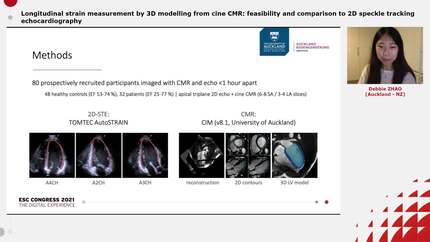
Measurements of LV deformation were performed by means of high-resolution two-dimensional (2D) speckle tracking echocardiography (STE) and compared with values obtained by 2D feature tracking echocardiography (FT-E) and feature tracking cardiac magnetic resonance imaging (FT-CMR). Assessments with echocardiography started within 30 min after CMR examination to minimize time-dependent variations in myocardial function. Forty-seven patients were included. Assessments by STE were −15.7 ± 5.0% for global longitudinal strain (GLS), −14.6 ± 4.5% for global circumferential strain (GCS), and 21.6 ± 13.3% for global radial strain (GRS), while values obtained with FT-E were −13.1 ± 4.0, −13.6 ± 4.0, 20.3 ± 9.5, and with FT-CMR −15.0 ± 4.0, −16.9 ± 5.4, and 35.0 ± 10.8, respectively. Linear regression and the Bland–Altman analysis showed the best intramodal association for STE GLS and FT-E GLS (
In our study, measurement of global longitudinal LV strain using the new FT algorithm with CMR and echocardiography was comparable with measurements obtained by high-resolution STE. Compared with echocardiographic EF determination, FT-E GLS shows a better reproducibility and a better intermodal agreement with CMR, representing a fair non-proprietary solution for this assessment.
clinicaltrials.gov. Unique identifier: NCT01275963.
Contributors

Marius Keller
Author
Sebastian Greiner
Author
Henning Steen
Author
Fabian aus dem Siepen
Author
Johannes Riffel
Author
Hugo A. Katus
Author
Sebastian J. Buss
Author
Derliz Mereles
Author
You may be interested in