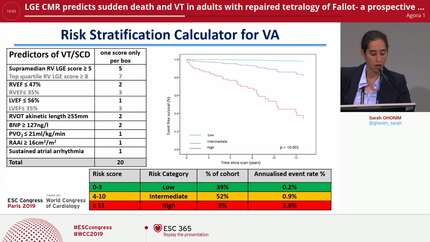
The relationship between cardiovascular magnetic resonance imaging measurement of extracellular volume fraction and clinical outcomes in adults with repaired tetralogy of Fallot

European Heart Journal - Cardiovascular Imaging

17 October 2017
Organised by: Logo
ESC Journals

Abstract

AbstractAims

Our aims were to explore cardiac magnetic resonance quantification of myocardial extracellular volume (ECV) in adults with repaired tetralogy of Fallot (rTOF) when compared with healthy controls and to investigate the association between ECV and major adverse cardiovascular outcomes.

Methods and results

We prospectively recruited adults with rTOF (n = 44, 59% male, 32.9 ± 13.6 years) and evaluated right ventricular (RV) and left ventricular (LV) ECV by pre/post-gadolinium T1 measurements (modified Look–Locker inversion recovery technique) on a 1.5-T Siemens scanner compared with the healthy controls (n = 10, 50% male, 31.5 ± 4.4 years). The primary end point was a composite of death, out-of-hospital cardiac arrest, heart failure (HF) requiring admission for escalation of therapy, or haemodynamically significant ventricular tachycardia (VT) (lasting >30 s and/or resulting in invasive therapy). The association between ECV and adverse events was assessed using Cox proportional hazard models [median follow-up 236 days, interquartile range (IQR) 38–342]. RVECV was higher in patients compared with the controls (31.5 ± 5.4% vs. 26.3 ± 2.1%, P = 0.027). The following major adverse events occurred (n = 9, 21%): death (n = 1), out-of-hospital cardiac arrest (n = 1), HF (n = 1), and VT (n = 6). RVECV was higher among those with an adverse event compared to those without (35.0 ± 5.5% vs. 29.6 ± 4.5%, P = 0.014) and was associated with increased risk for adverse events [hazard ratio 1.13, 95% confidence interval (1.01–1.28); P = 0.037]. LVECV was not associated with adverse events (P = 0.667).

Conclusion

Increased RVECV is associated with adverse cardiovascular events in adults with rTOF. These results may lead to further studies exploring the potential role for RVECV in risk stratification and targeted therapeutic interventions in this population.

Contributors