Defining the prognostic value of [15O]H2O positron emission tomography-derived myocardial ischaemic burden
European Heart Journal - Cardiovascular Imaging


Abstract
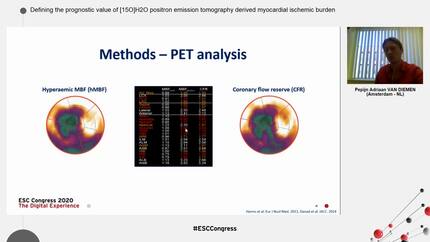
Myocardial ischaemic burden (IB) is used for the risk stratification of patients with coronary artery disease (CAD). This study sought to define a prognostic threshold for quantitative [15O]H2O positron emission tomography (PET)-derived IB.
A total of 623 patients with suspected or known CAD who underwent [15O]H2O PET perfusion imaging were included. The endpoint was a composite of death and non-fatal myocardial infarction (MI). A hyperaemic myocardial blood flow (hMBF) and myocardial flow reserve (MFR)-derived IB were determined. During a median follow-up time of 6.7 years, 62 patients experienced an endpoint. A hMBF IB of 24% and MFR IB of 28% were identified as prognostic thresholds. Patients with a high hMBF or MFR IB (above threshold) had worse outcome compared to patients with a low hMBF IB [annualized event rates (AER): 2.8% vs. 0.6%,
A hMBF IB ≥24% was a stronger predictor of adverse outcome than an MFR IB ≥28%. Nevertheless, classifying patients according to concordance of IB result allowed for the identification of low- and high-risk patients.
Contributors

Pepijn A van Diemen
Author
Jan-Thijs Wijmenga
Author
Roel S Driessen
Author
Michiel J Bom
Author
Stefan P Schumacher
Author
Wynand J Stuijfzand
Author
Henk Everaars
Author
Ruben W de Winter
Author
Pieter G Raijmakers
Author
Peter M van de Ven
Author
Albert C van Rossum
Author
Ibrahim Danad
Author
Paul Knaapen
Author
You may be interested in