AI-AIF: artificial intelligence-based arterial input function correction for quantitative stress perfusion cardiac MRI
European Heart Journal - Cardiovascular Imaging


Abstract
Type of funding sources: Public grant(s) – National budget only. Main funding source(s): Wellcome Trust
The quantification of myocardial blood flow (MBF) from stress perfusion cardiac magnetic resonance (CMR) has the potential to facilitate the widespread clinical adoption of stress perfusion CMR. However, one of the major challenges of MBF quantification is the estimation of the arterial input function (AIF) as required for the tracer-kinetic modelling. Since high concentrations of contrast agent are recorded at the peak of the AIF, the non-linear relationship between the concentration of gadolinium and the measured MR signal leads to signal saturation. Current solutions include the use of dual-bolus or dual-sequence acquisitions but both have limited clinical adoption. Therefore, there is a clear unmet need for an AIF estimation approach that is both widely available and easy to integrate in clinical routine, with the ideal acquisition being with a single-bolus and single-saturation sequence.
In this work, we propose the artificial intelligence-based AIF (AI-AIF). In particular, we show that a deep learning model can be trained to predict the unsaturated AIF from a saturated single-bolus, single-sequence AIF, using the reference standard dual-sequence AIFs (DS-AIFs) for training.
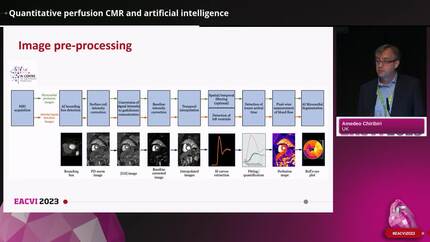
This was a multicentre retrospective study, including data from two UK centres with institutional ethical approval. The training dataset was a retrospective sample of patients exclusively from centre 1 (n=218), and a test set was comprised of both an independent cohort of consecutive patients from centre 1 and an external cohort of patients from centre 2 (n=44) to test the generalisation of the model. A 1D U-Net convolutional network was used with 5 resolution steps of two 1D convolutional blocks with batch normalisation, ReLU activations, and dropout (probability=0.2). 1D max-pooling and transposed convolutions are used for down and upsampling respectively. The model was trained for 200,000 iterations (including data augmentation), with a batch size of 10 using the ADAM optimization algorithm (learning rate, 0.001) to minimise the mean squared error between the predicted and reference standard unsaturated AIFs. MBF was quantified in a fully-automated manner (1,2) and compared between the DS-AIF and AI-AIF methods using the Mann-Whitney U test and Bland-Altman analysis.
There was no statistical difference between the median MBF quantified with the DS-AIF (2.77 ml/min/g (1.08)) and quantified with the AI-AIF (2.79 ml/min/g (1.08), p = 0.33.
Quantification of stress perfusion CMR is feasible with a single-sequence acquisition and a single contrast injection using an AI-based correction of the AIF.
Contributors

C M Scannell
Author
E Alskaf
Author
N Sharrack
Author
S Plein
Author

A Chribiri
Author
St Thomas' Hospital and King's College London London , United Kingdom of Great Britain & Northern Ireland
You may be interested in