Predicting stroke in heart failure and reduced ejection fraction without atrial fibrillation
European Heart Journal


Abstract
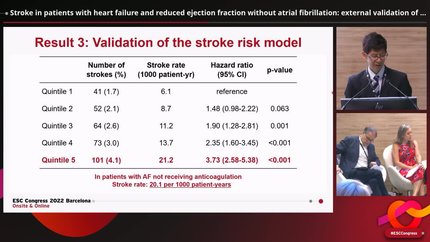
Patients with heart failure with reduced ejection fraction (HFrEF) are at significant risk of stroke. Anticoagulation reduces this risk in patients with and without atrial fibrillation (AF), but the risk-to-benefit balance in the latter group, overall, is not favourable. Identification of patients with HFrEF, without AF, at the highest risk of stroke may allow targeted and safer use of prophylactic anticoagulant therapy.
In a pooled patient-level cohort of the PARADIGM-HF, ATMOSPHERE, and DAPA-HF trials, a previously derived simple risk model for stroke, consisting of three variables (history of prior stroke, insulin-treated diabetes, and plasma
It is possible to identify a subset of HFrEF patients without AF with a stroke-risk equivalent to that of patients with AF who are not anticoagulated. In these patients, the risk-to-benefit balance might justify the use of prophylactic anticoagulation, but this hypothesis needs to be tested prospectively.
Contributors


Azmil H Abdul-Rahim
Author
Atefeh Talebi
Author
William T Abraham
Author
Akshay S Desai
Author
Kenneth Dickstein
Author
Silvio E Inzucchi
Author
Lars Køber
Author
Mikhail N Kosiborod
Author
Felipe A Martinez
Author

Mark Petrie
Author
Piotr Ponikowski
Author
Jean L Rouleau
Author
Marc S Sabatine
Author
Karl Swedberg
Author
Michael R Zile
Author
Scott D Solomon
Author
Pardeep S Jhund
Author

John J V McMurray
Author
University of Glasgow Glasgow , United Kingdom of Great Britain & Northern Ireland
You may be interested in